
SaaS Security Certifications: What Each One Proves

A SaaS security certification is independent proof that a provider runs its security in a defined, checked way. The most common are an ISO 27001 certificate, a SOC 2 report and, for card data, PCI DSS. For EU companies the real task is to hold the right few, keep their scope honest and reuse the same evidence for every customer questionnaire, NIS2 supplier check and DORA review. Doing it once in one system is what keeps a 10 to 250 person company from rebuilding the same proof for each buyer.
Certification, attestation and report: three different things
Buyers use the word “certified” loosely, and the loose use causes most of the friction in security reviews. Three kinds of proof sit under it.
A certification is a judgment of conformity against a standard, issued by an accredited certification body. ISO 27001 works this way: the outcome is certified or not certified, for a stated scope. You can read how the standard is built and who it covers on our ISO 27001 overview.
An attestation report is an independent auditor’s written opinion on controls. SOC 2 is the best known example. The deliverable is a report that describes your system and the auditor’s findings, which is why a SOC 2 buyer asks to read the report instead of looking for a certificate number. Our SOC 2 page explains who it covers.
A technical test report, such as a penetration test or a vulnerability assessment, shows what a tester found in a specific system at a specific time. It sits alongside the first two and answers a different question: not whether your management process is sound, but whether this application can be attacked.
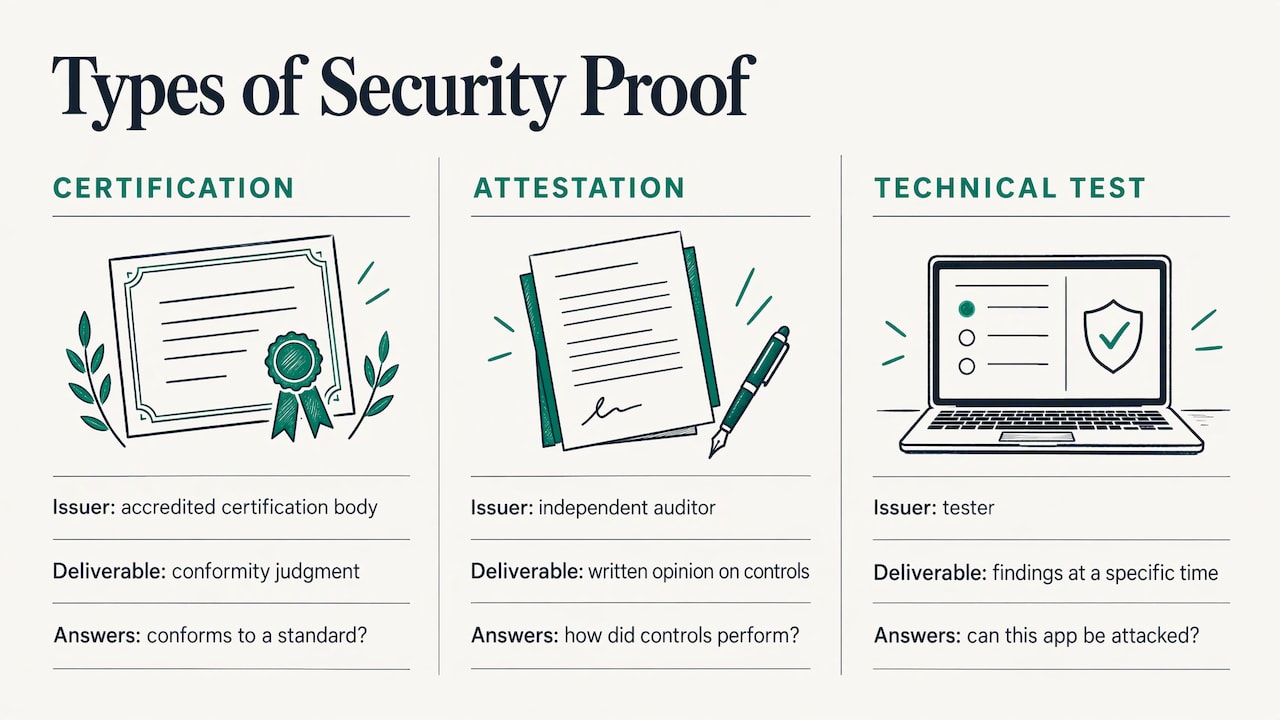
ENISA, the EU cybersecurity agency, studied how auditing schemes are built and found that every one of them hands the actual auditing to third-party auditors, though each constructs that delegation differently (ENISA, Auditing Security Measures). The practical lesson for a SaaS provider is that the weight of any certificate comes from who issued it and how it is overseen. When you describe your proof to a customer, name the type correctly. A provider who says “SOC 2 certified” invites a pushback that a provider who says “we hold a SOC 2 report” avoids.
Which certifications matter for a SaaS provider
No single document covers everything. Organisation level proof tells a buyer about your processes. Product level proof tells them about a specific technology. Most SaaS buyers ask for the first kind, and a few ask for the second.
| Proof | What it covers | Who usually asks for it |
|---|---|---|
| ISO 27001 certificate | Your information security management system, for a stated scope and sites | EU customers, public bodies, regulated buyers |
| SOC 2 report | Controls against defined trust criteria, at a point in time (Type 1) or over a period (Type 2) | Buyers with international or enterprise procurement |
| PCI DSS | Protection of payment card data | Any buyer whose SaaS touches cardholder data |
| Cyber Essentials | A baseline set of technical controls | UK buyers and public sector suppliers |
| Penetration test report | Technical findings in a tested system | Security teams during due diligence |
The PCI DSS page covers who must comply, and our guide to penetration testing for PCI compliance shows what assessors expect from a test. If you sell into the UK, the Cyber Essentials page explains the scheme.
A practical order for a 10 to 250 person SaaS company: start with the standard your first large customers actually name in their questionnaires, then add the second when it saves you repeated answers. For European buyers that is very often ISO 27001. The reason to sequence them is that most of the work is shared. Policies, a risk register, access control evidence, supplier management and incident handling are asked for in nearly every framework.
What the EU schemes add
The EU has its own cybersecurity certification framework. The European Commission explains that a certificate under it carries an assurance level of basic, substantial or high, and that the high level targets the most sophisticated attack methods, to protect sensitive industry or government data (European Commission).
Two schemes are worth knowing by name:
- EUCC is the common criteria based scheme for ICT products. Its certificates are issued at substantial or high assurance, self-assessment is not permitted, and certificates are valid for up to five years with periodic review (EUR-Lex summary). It is about products, so it matters if you ship a hardware or software product rather than a hosted service.
- EUCS is ENISA’s candidate scheme for cloud services, with the same three levels. ENISA describes the basic level as a minimum baseline covering all major aspects of cloud security, usable by cloud providers of any size (ENISA, EUCS candidate scheme). It is described there as a candidate scheme, so follow the Commission’s pages for its status before you plan around it.
For most SaaS companies today, ISO 27001 and, where the market asks, a SOC 2 report remain the working documents. The EU schemes are a development to watch, not a reason to delay the certificate your next customer is asking for.
What EU buyers ask you to demonstrate
The reader on the other side of your sales process has obligations of their own, and those shape the questions you receive.
Financial entities under DORA
A bank, insurer or other financial entity in scope of DORA, the EU’s digital operational resilience regulation, must assess a prospective ICT provider’s information security, resources, risk management and controls. The Commission’s regulatory technical standard on ICT third-party policy says the entity sets an assurance level using independent assessments, audit reports, certifications or other information. It also says the entity should not rely solely on certifications or reports over time, and should check their scope, currency, auditor and testing of operational effectiveness, while keeping contractual audit rights (Commission Delegated Regulation (EU) 2024/1531 annex).
For you as the SaaS provider, that tells you what to prepare. A certificate is welcome, and it will be read against four things: its scope, how recent it is, who issued it and whether controls were tested in operation. Keep those four answers ready in a one page summary that sits with the certificate.
Organisations under NIS2
NIS2 is the EU directive that sets cybersecurity risk management duties for essential and important entities, including supply chain security. Your customers in scope will ask you how you manage risk, incidents and access. ENISA’s June 2025 technical implementation guidance for NIS2 risk management measures maps each requirement to ISO/IEC 27001:2022 and ISO/IEC 27002:2022, along with other frameworks. It also states that a single piece of evidence may support several requirements, that partial implementation of a mapped standard does not assume compliance, and that the mapping is not a measure of equivalency among standards (ENISA technical implementation guidance).
Take two points from that. First, an ISO 27001 programme gives you a structure NIS2 customers recognise. Second, the evidence still has to be real and complete, because a half finished control set does not count as compliance with anything.
How buyers check your certificate, and how to make it pass
Security teams follow a predictable routine. Preparing for it saves days in every deal. The Austrian National Bank publishes a certificate review checklist for ISO 27001 that shows the logic well. It tells the reviewer to verify the certificate with the certification body, check that the certified company’s name and address match the service provider, and confirm that the services used are inside the certification scope. It also advises checking issue and expiry dates, whether a certification or recertification audit was performed, and whether surveillance audits and any conditions or deficiencies are documented (Austrian National Bank certificate review checklist).
Turn that into a list for your own side:
- Match the legal entity. The name and address on the certificate should be the contracting company. If a subsidiary or a brand name appears, explain the link in writing.
- State the scope in service terms. A scope that names your product and the sites that run it is far more useful to a buyer than a generic description of the organisation.
- Keep dates current. Show the issue date, the expiry date and the latest surveillance audit, so a reviewer does not need to ask.
- Prepare a summary of applicable controls. Reviewers want to see which controls apply and how, without reading the whole management system.
- Be ready for reports with exceptions. For attestation reports, reviewers read the opinion, the exceptions and the management responses. A clear remediation record reads better than silence.
A certificate shows the state of your management system at the time of assessment, for a defined scope. It does not say that a particular product has no vulnerabilities. That is why buyers also ask for technical evidence such as penetration test summaries. A SaaS security checklist gives a compact list of priority checks that sit around the certificates and are worth running before a customer review.
Reusing one evidence set across standards
The expensive mistake is treating each certificate as a separate project. A company that certifies to ISO 27001, then answers NIS2 supplier questionnaires, then a DORA customer’s due diligence, then a SOC 2 request, ends up with four sets of documents and four people chasing screenshots.
The better model is one set of policies, risks, controls and evidence, mapped to each framework. ENISA’s note that one piece of evidence can support several requirements describes the principle. An access review log, for example, speaks to access control in ISO 27001, to identity and access requirements in NIS2 and to ICT security expectations a DORA customer raises.
Three habits make the reuse safe:
- Map once, review often. Keep a control library where each control links to the requirements it supports, and review the mapping when a standard changes.
- Never claim more than the mapping supports. ENISA is explicit that mapping is not equivalence. Say “this evidence supports requirement X”, and note where a framework asks for something extra.
- Date everything. Evidence has a collection date. An evidence register that records when each item was gathered and by whom lets you answer “how recent is this?” without searching.
Consultants who manage several clients meet the same problem at larger scale. The same logic applies per client: one library, many mappings, a clear record of what was shown to whom.
Where Guardiso fits
Guardiso is a platform for managing information security and regulatory compliance. In one system, a company runs ISO 27001, GDPR, NIS2, DORA, SOC 2, ISO 22301 and about 30 other standards. One set of documents and evidence serves many regulations, so the team does not repeat the same work for each new framework.
For a SaaS provider preparing proof for customers, the platform covers the parts that usually cost the most time:
- Standards mapping, so a control and its evidence are linked to every requirement it supports.
- Document and policy templates, with ready policies in English and Polish. Guardiso drafts the documentation and your team approves it.
- Risk and evidence registers, audit planning and automatic evidence collection through integrations.
- An auditor portal with electronic signatures, and a complete evidence pack prepared before an audit.
- A public Trust Center and compliance questionnaires, so customers see your compliance status and you share it through a security portal.
- A board dashboard showing compliance status, risks and open tasks.
The database and files are hosted in Poland, which matters to EU buyers asking where their supplier’s data sits. Guardiso is an ISO 27001 certified company. You can read how we protect customer data on the Guardiso security page.
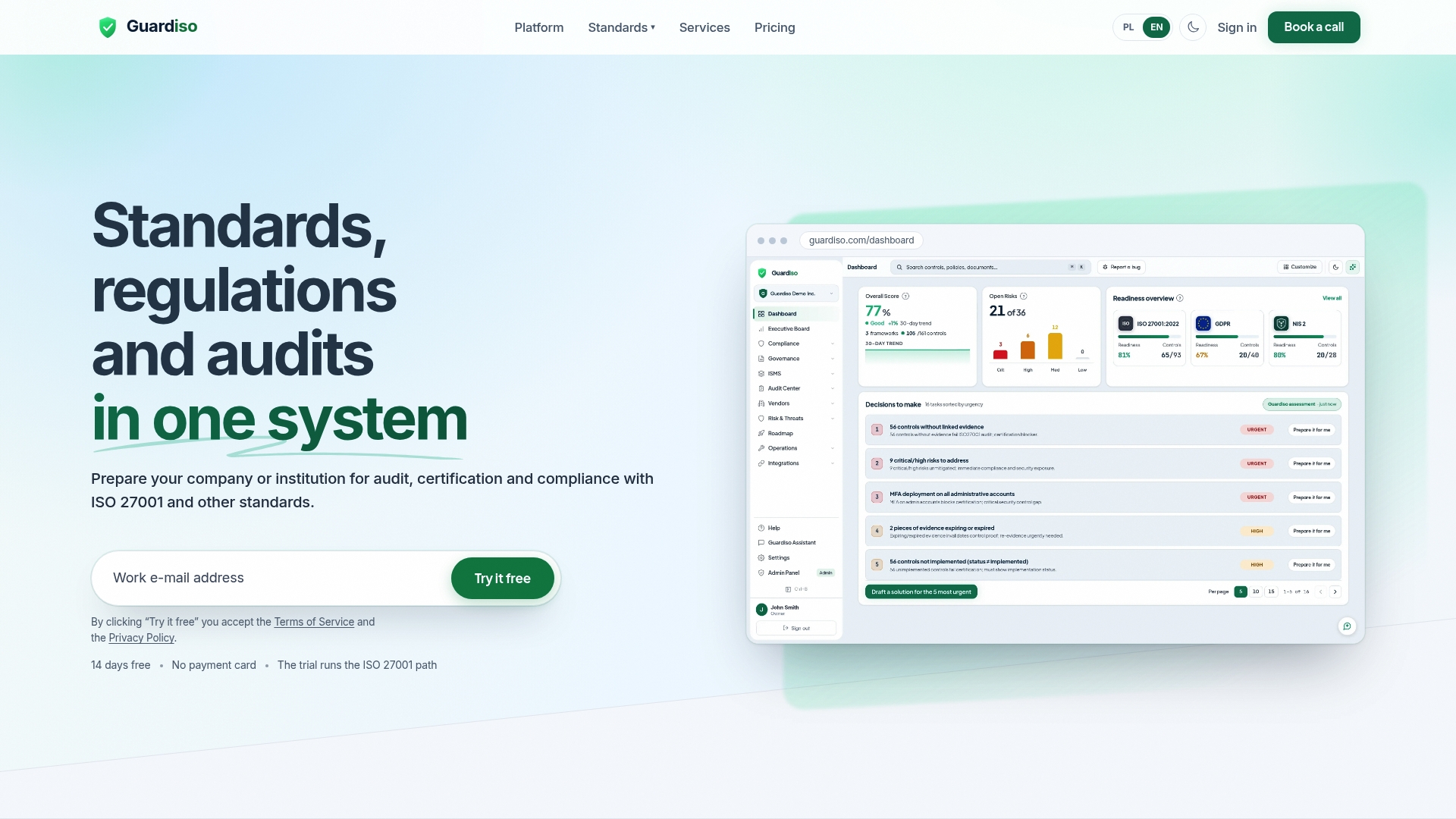
Plans are published: Starter is €199 per month and Professional is €499 per month, with Enterprise on request. See the pricing page to compare them. If you want a technical layer next to your management system, Guardiso also offers penetration tests, vulnerability assessments and security audits for ISO, NIS2 and DORA, and a vCISO service for companies that need a part-time security officer.
If you are choosing software to run several standards, our guide on how to choose compliance management software for several standards sets out the criteria.
A sensible sequence for a growing SaaS company
Here is a plan that fits a company of 10 to 250 people.
- Read your customers’ requests. List the standards named in the last ten questionnaires and contracts. The most frequent one is your first target.
- Define a scope your buyers recognise. Name the product, the teams and the sites involved. A scope that is too narrow will be questioned, and one that is too wide will be expensive to maintain.
- Build the shared core. Policies, risk register, asset list, supplier register, access reviews, incident log and training records are used by almost every framework.
- Collect evidence continuously. Gathering it in the weeks before an audit is slow and error prone. Integrations that collect it as you work remove most of that effort.
- Add technical testing. A penetration test of the main application and an external vulnerability assessment give buyers the technical layer that a management certificate does not.
- Publish what you can. A Trust Center and a ready answer set for questionnaires shorten sales cycles, because the security team gets what it needs without a call.
- Add the next framework through mapping. When NIS2 or DORA customers appear, map your existing controls first and close only the gaps.
For the standards, the Guardiso blog covers ISO 27001, NIS2 and GDPR in practice, and the Guardiso home page gives an overview of the platform.
FAQ
Is there a SOC 2 certificate?
SOC 2 produces a report written by an independent auditor, so describe it as a SOC 2 report. ISO 27001 is the standard that results in a certificate issued by a certification body. Using the right term in your sales material avoids questions from careful buyers.
Which certification should an EU SaaS company get first?
Choose the one your customers name most often. For European buyers that is frequently ISO 27001, because it fits NIS2 and DORA supplier expectations and the evidence is reusable. Add SOC 2 or PCI DSS when your market or your card data handling calls for it.
Does an ISO 27001 certificate prove that my product is secure?
It shows that your management system covers a defined scope and was assessed by an accredited body. Buyers usually pair it with technical evidence such as penetration test summaries. Prepare both so the review closes quickly.
What will a DORA customer check in my certificate?
They will look at its scope, how current it is, who issued it and whether operational effectiveness was tested, as the Commission’s standard on ICT third-party policy sets out. Keep a one page summary of those four points with the certificate, and agree audit rights in the contract.
Sources
- ENISA, Auditing Security Measures
- European Commission, European cybersecurity certification framework
- EUR-Lex, EUCC summary
- ENISA, EUCS candidate cloud services scheme
- Commission Delegated Regulation (EU) 2024/1531 annex
- ENISA, technical implementation guidance on NIS2 risk management measures
- Austrian National Bank, certificate review checklist