
Compliance Management Software: How to Choose for Several Standards
The best compliance management software for a company of 10 to 250 people is the one that lets you write a policy once, attach evidence once and reuse both across ISO 27001, GDPR, NIS2, DORA and ISO 9001. Everything else on a feature sheet matters less than that. If each new standard means a new spreadsheet, a new document set and a new round of evidence requests, the tool is a filing cabinet and not a compliance system.
This guide gives you seven criteria for comparing platforms, the price models you will meet, and a short scorecard you can fill in before any demo. It is written for EU companies that must prove compliance to customers, organisations in scope of NIS2, financial entities under DORA, teams preparing for ISO 27001 certification and consultants who run compliance for several clients.
What compliance management software actually does
Compliance management software, often called GRC software (governance, risk and compliance), keeps the working parts of your compliance programme in one place. Those parts are the policies and procedures, the risk register, the list of controls, the evidence that each control works, the tasks that keep it all current and the audit trail.
A good platform does four jobs:
- Maps requirements. It links the clauses of each standard to your controls, so you can see which control covers which requirement.
- Holds the documents. It supplies policy and procedure templates and tracks approvals and review dates.
- Collects evidence. It pulls proof of control operation from the systems you already use, and stores manually uploaded proof where automation is not possible.
- Prepares the audit. It shows status, open risks and open tasks, and assembles what an auditor will ask for.
The difference between platforms lies in how well each of those jobs is done. Crowe’s October 2025 guidance on choosing a compliance platform makes the point that even platforms with similar features differ in usability and effectiveness, and recommends a scorecard so that vendor comparison is objective rather than based on feature lists. The seven criteria below are built to feed such a scorecard.
Criterion 1: one set of documents and evidence for many standards
This is the criterion that decides the cost of your programme over three years.
Most standards ask for overlapping things. An access control policy, a supplier assessment, an incident response procedure and a backup test record appear, in different words, in ISO 27001, NIS2, DORA and in customer security questionnaires. If the software treats each standard as a separate project, your team writes and evidences the same control several times. If it treats the control as the unit of work and maps it to every standard that needs it, you do the work once.
Test it in a demo with a concrete request:
- Ask the vendor to show one control, for example supplier risk management, and list every requirement in every supported standard it satisfies.
- Ask what happens when you add a second standard to a company already certified against the first. You want to hear that existing controls and evidence carry over and that only the gaps appear as new tasks.
- Ask how many standards are supported and whether you can add your own internal standard or a customer’s requirements as a framework.
For a company adding NIS2 on top of an existing ISO 27001 programme, the reuse question is the whole business case. Our guide to NIS2 compliance software and how to choose a tool goes through the NIS2 side in more detail, and the ISO 27001 software guide covers the certification side.
Criterion 2: automatic evidence collection from cloud tools
Evidence is where compliance work turns into admin. Screenshots of settings, exports of user lists, proof that a laptop is encrypted, records that a ticket was closed: collected by hand, they take days before every audit and are out of date the moment they are taken.
Crowe’s scorecard lists automated evidence collection, continuous monitoring with alerting, and integrations with cloud infrastructure, identity providers and ticketing systems as core selection items. Turn that into questions:
- Which cloud providers, identity providers, code repositories, device managers and ticketing tools does the platform connect to out of the box?
- Does the integration read configuration continuously, or does it only take a snapshot when you click a button?
- When a control fails, who is alerted and does a task open automatically?
- What happens to controls that no integration can reach? There should be a clean way to upload and date manual evidence.
A documentation-only tool is not a fault in itself, but know which one you are buying. The Knowledge Engineers’ 2026 comparison notes that one European tool in its list assigns and documents tasks rather than watching cloud accounts, so buyers there should pair it with their own technical monitoring. Decide up front whether you want evidence gathered by the platform or by your people. For a deeper look at how the mechanism works, see our explainer on automated evidence collection for audits, and the wider compliance automation guide.
Criterion 3: auditor and partner access
An audit is a series of requests: show the policy, show who approved it, show the last access review, show the risk treatment decision. Every request answered by email is time lost on both sides.
Look for:
- A dedicated auditor portal. The auditor gets read access to exactly the scope you choose and nothing else, and requests and answers stay in the system.
- Electronic signatures. Management approvals and statements of applicability are signed and dated in the platform, which leaves a clean record.
- An evidence pack. Before the audit, the platform should assemble the policies, registers and evidence for the scope into one package, so you review it before the auditor does.
- Sharing with customers. Many customers now send security questionnaires. A public or private trust page, and the ability to answer questionnaires from existing controls, shortens sales cycles for suppliers.
For consultants, the same logic applies per client: you need separate, clearly isolated client environments, the ability to reuse your own templates and control libraries across clients, and a way to give each client’s auditor access to that client only. Ask any vendor how multi-client management is licensed, because it is often priced differently from a single-company plan.
Criterion 4: data residency and hosting in the EU
A compliance platform holds sensitive material: your risk register, vulnerabilities, supplier contracts, incident records and internal policies. Where that data sits matters to your customers, your data protection officer and, for regulated sectors, your supervisor.
Crowe’s scorecard includes data storage location and third parties among the items to assess. In practice, ask the vendor:
- In which country are the database and uploaded files stored?
- Which sub-processors does the vendor use and where are they based?
- Does the vendor hold its own security certification, and can you read its security documentation before signing?
- Is there a data processing agreement under GDPR, and is it the vendor’s standard document or negotiated?
Storage exclusively in EU data centres is a selling point you will see stated on some vendors’ pricing pages, and it removes a category of transfer questions from your own GDPR records. For organisations in the EU, treat it as a requirement and not a nice-to-have.
Criterion 5: pricing transparency
Prices in this market fall into three groups: published monthly plans, published annual plans, and quote-only. The Knowledge Engineers’ 2026 comparison of 13 tools for EU SMEs shows the spread. Published entry prices there range from €1,199 a year for a Croatian tool to €3,200 a year for a Finnish tool aimed at companies under 20 employees, and from €290 a month (up to 50 employees, one framework) to €690 a month (up to 250 employees, three frameworks) for a German-hosted platform. Several other tools in the same comparison are quote-only.
When you set offers side by side, normalise them:
| Question | Why it changes the real price |
|---|---|
| How many frameworks are included? | A plan that covers one standard becomes expensive when NIS2 or DORA is added. |
| How many employees or users? | Limits often set the tier you must buy. |
| Are integrations included? | Some vendors charge per connector. |
| Is the auditor portal included? | It may be an add-on. |
| Are templates and policies included? | Check the languages you need. |
| Is there support or expert help? | Onboarding and audit support may be extra. |
| Monthly or annual billing? | Annual is usually cheaper but fixes the commitment. |
A vendor who publishes plan prices lets you build a budget before the first call. A quote-only vendor can still be right for a large organisation, but for a company of 10 to 250 people a published price saves a week of procurement.
Criterion 6: coverage of the standards you actually face
List your obligations before you list vendors. For most readers of this guide, the list is some mix of the following.
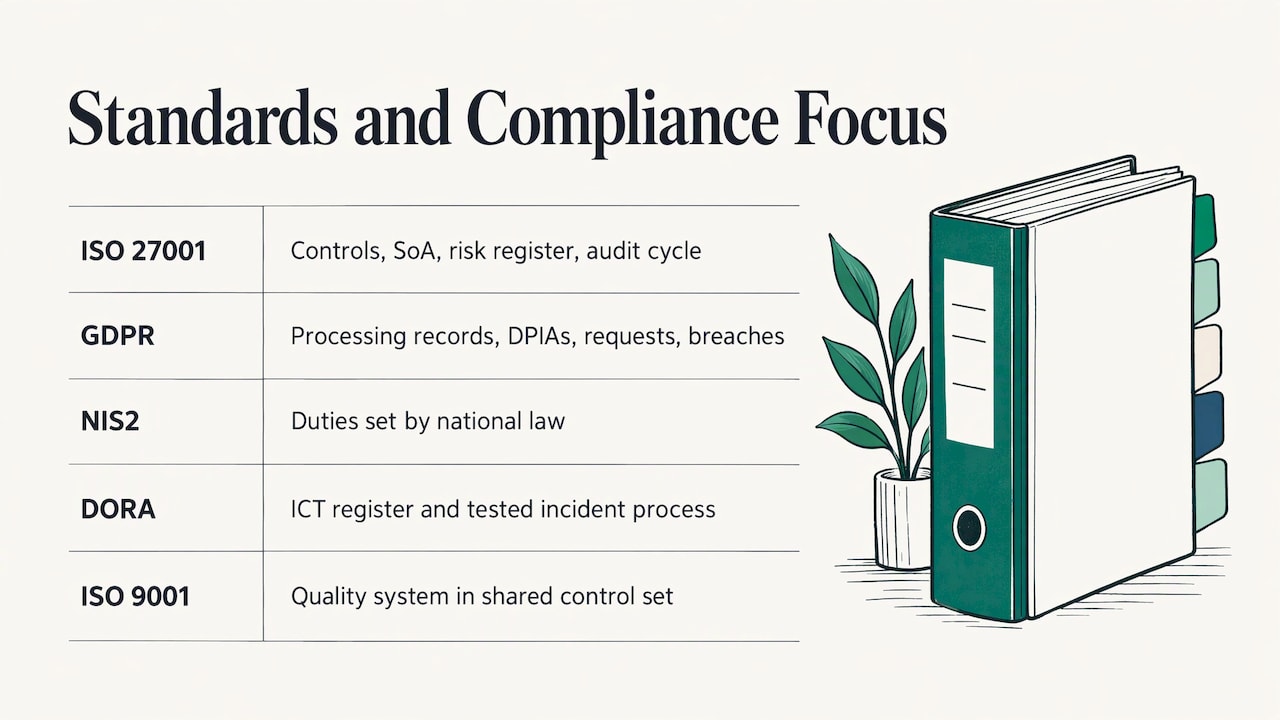
ISO 27001. The international standard for an information security management system. Certification is awarded by an independent certification body after an audit, and customers often ask for it. The platform should cover the controls, the statement of applicability, the risk register and the internal audit and management review cycle.
GDPR. The EU data protection regulation. The platform should hold your records of processing, support data protection impact assessments and track data subject requests and breaches.
NIS2. The EU directive on the security of network and information systems, which applies to organisations in a wide range of sectors by size and type. It is a directive, so each member state transposes it into national law, and the national act determines your exact duties. If you operate in Poland, see our page on software for the Polish KSC act. The NIS2 overview explains who is covered.
DORA. The Digital Operational Resilience Act, which applies to financial entities in the EU and to their critical ICT providers. According to a presentation from the French supervisor ACPR, DORA applies to 20 categories of financial entity, and it takes precedence over NIS2 for cyber risk and incident notification where both apply. The same presentation describes 2025 as an accompaniment year and 2026 as the start of reinforced supervision, with a transsectoral DORA questionnaire, attention to the quality of the register of information and to major incident notifications. For a financial entity, that makes a well-kept register of ICT third-party arrangements and a tested incident process practical priorities when you pick software. Our DORA overview explains who it covers, and this advisory on DORA identity controls looks at one area compliance teams must handle.
ISO 9001 and others. If you run a quality management system as well, check that the platform can hold it in the same control set. A single integrated management system is the efficient route for companies that already certify against more than one standard. See the full list of standards and the overview of regulations by industry to confirm what applies to your sector.
Criterion 7: readiness for ISO 27001 certification
If your immediate goal is a certificate, test the platform against the certification path and not against a feature list. A realistic route for a small company is described in this piece on getting to ISO 27001 with a narrow scope. Whatever scope you choose, the platform should help you do each of these:
- Define the scope and context of the management system.
- Run a risk assessment, record treatment decisions and link them to controls.
- Produce the statement of applicability.
- Hold policies with owners, approvals and review dates.
- Plan and record internal audits and management reviews.
- Track corrective actions to closure.
- Hand the auditor an evidence pack.
Ask for a walkthrough of exactly this sequence with your own scope, not a generic tour. If the vendor drafts policies for you to approve, check that they are available in the languages your staff and auditor use.
A scorecard you can use before any demo
Crowe recommends a scorecard, and a simple one is enough. Score each vendor from 0 to 3 on every row, weight the rows that matter most to you, and compare totals.
| Criterion | What a 3 looks like |
|---|---|
| Reuse across standards | One control maps to every standard; adding a framework shows only gaps |
| Evidence collection | Native integrations with your cloud, identity and ticketing tools, with alerts |
| Auditor access | Scoped portal, e-signatures, evidence pack |
| Data residency | Database and files stored in the EU, security documentation available |
| Price transparency | Published plans, clear limits, no surprise add-ons |
| Standards coverage | Every standard you face, plus your own |
| Certification readiness | Full ISO 27001 cycle supported end to end |
| Usability and support | Your team can complete a task without training |
Run the same three tasks with every vendor: add a policy and route it for approval, connect one integration and show the resulting evidence, and map one control to two standards. Scores from identical tasks are the fairest comparison you will get.
Where Guardiso fits
If your list of criteria looks like the one above, Guardiso is built around it. One set of documents and evidence serves ISO 27001, GDPR, NIS2, DORA and about 30 other standards, so the team does not repeat work for each new framework. The platform drafts documentation for your team to approve, with ready policies in English and Polish, shows compliance status, risks and open tasks, collects evidence through integrations and prepares a complete evidence pack for the auditor, who can sign off through an auditor portal with electronic signatures. The database and files are hosted in Poland, and Guardiso is an ISO 27001 certified company.
Plans are published: Starter is €199 per month and Professional is €499 per month, with custom pricing on Enterprise. Details are on the pricing page. Where you also need expert hands, Guardiso offers penetration tests, vulnerability assessments, security audits and a virtual security officer service alongside the platform.
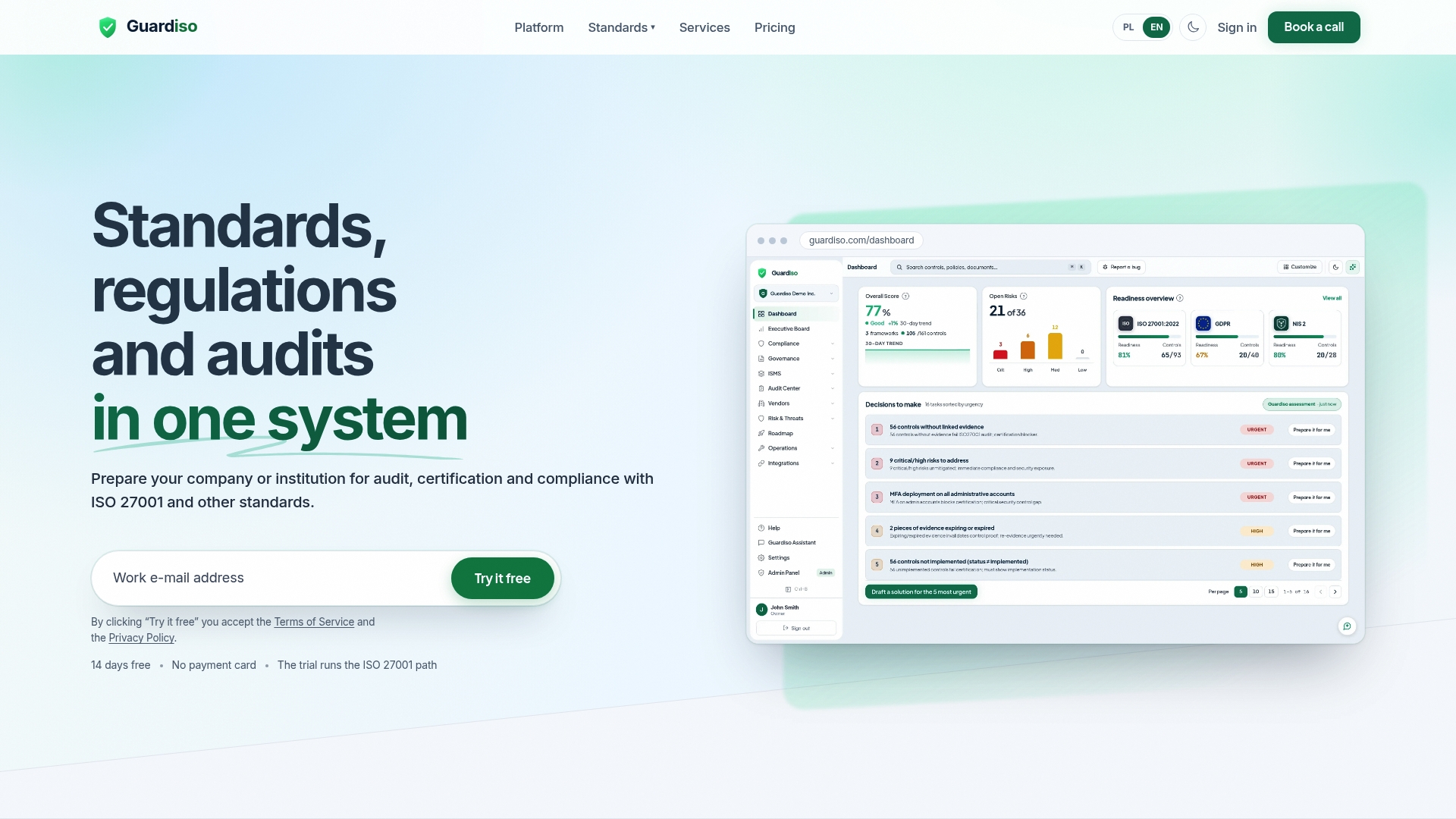
For a look at how integrations and evidence work in practice, see the compliance platform page.
FAQ
What is compliance management software?
It is a platform that keeps policies, risks, controls, evidence and audit tasks for one or more regulations and standards in one system. It shows your status against each requirement and helps you prepare for audits. It is often sold as GRC software.
Do I need separate software for each standard?
No. Many controls are shared between ISO 27001, GDPR, NIS2 and DORA, so a platform that maps one control to several standards lets you write and evidence it once. That is the main saving for a company managing more than one framework.
How much does compliance management software cost for a small or mid-sized company?
Published prices vary with the number of frameworks, employees and features. A 2026 comparison of tools for EU SMEs lists entry prices from €1,199 a year up to €690 a month, and some vendors only give quotes. Compare plans on frameworks, users, integrations and auditor access.
Can consultants use compliance software for several clients?
Yes, provided the platform keeps each client’s data and evidence separate and lets you reuse your templates and control libraries. Ask how multi-client use is licensed, and whether each client’s auditor can be given access to that client only.
Sources
- 5 Steps to Choosing a Compliance Platform, Crowe
- Best Compliance Management Software in 2026, The Knowledge Engineers
- Présentation DORA, ACPR