
NIS2 Compliance Requirements: What Your Company Must Do

NIS2 (Directive (EU) 2022/2555) asks in-scope organisations for four things: a documented cybersecurity risk-management programme, board-level accountability, incident reporting to the national authority on a fixed timetable, and control over the security of suppliers. The practical difficulty is proving all four with current evidence. Guardiso is a platform that keeps policies, risks, controls and evidence in one place, so a NIS2 programme can be built once and shown to an authority, a customer or an auditor from the same records.
This guide covers the requirements in the order a compliance lead meets them, using the official text of the Directive on EUR-Lex.
Who must comply with NIS2
The general scope sits in Article 2. It covers public and private entities in the sectors of Annex I and Annex II that are at least medium-sized and that provide their services or carry out their activities in the Union. The Directive also names exceptions that apply whatever the size, for example certain providers of public electronic communications networks and trust services, which the same article lists.
The European Commission’s NIS2 FAQ groups the sectors into two lists. Sectors of high criticality include energy, transport, health, banking, financial market infrastructures, digital infrastructure and public administration. Other critical sectors include postal and courier services, manufacturing, food and research. The FAQ also explains that Member States may identify smaller entities with a high security risk profile and bring them into scope.
Two practical points follow for a company with 10 to 250 employees:
- Size is only the first filter. A company with fewer than 50 staff can still be in scope if it is a named type of digital or trust-service provider, or if a Member State designates it.
- Supply chains carry the duty further. Even if you are below the threshold, a customer that is in scope must manage the security of its suppliers under Article 21, and it will ask you for evidence.
Manufacturers of electronics and machinery sit in Annex II, and those that also serve defence markets face dual-use technology export rules alongside their NIS2 duties.
A company based outside the EU, including in the United Kingdom, is covered where it operates in the Union. The national law of the Member State where you operate decides how the rules are applied to you. Our page on NIS2: what it is and who it covers walks through the scoping questions in more detail, and compliance regulations by industry helps when your company is subject to several regimes.
Essential or important entity
Article 3 sorts in-scope organisations into two categories. Essential entities generally include large Annex I entities, named digital and trust-service providers whatever their size, specified public administrations, and entities a Member State designates as essential. Other in-scope entities are generally important entities.
Both categories carry the same risk-management and reporting duties. The difference lies in supervision and penalties. Essential entities can expect supervision before problems arise, and important entities are generally supervised after evidence of non-compliance emerges. Both categories can face fines, set out below.
Write your classification down with the reasoning behind it: the sector, the size test, the Member State where you operate and any designation. That record is the first document an authority or a customer will look for.
The ten risk-management measures
Article 21 requires essential and important entities to take appropriate and proportionate technical, operational and organisational measures. They rest on an all-hazards approach, which means the measures protect systems and their physical environment against any cause of disruption, from cyberattacks to fire or power loss. Proportionality takes account of your risk exposure, the state of the art, the cost of implementation, your size and the likely impact of an incident.
Article 21(2) names the minimum topics. Each is listed here with what a reviewer will want to see.
| Article 21(2) topic | What evidence typically shows it |
|---|---|
| Risk analysis and information system security policies | Risk register, approved policy set, review dates |
| Incident handling | Incident procedure, log of events and responses |
| Business continuity, backup and crisis management | Continuity plan, backup records, exercise results |
| Supply chain security | Supplier list, risk ratings, contract clauses |
| Security in acquisition, development and maintenance, including vulnerability handling | Patch records, vulnerability scan results, change records |
| Policies to assess effectiveness of measures | Internal audit plan, test results, management review |
| Basic cyber hygiene and training | Training records, awareness programme |
| Cryptography and, where appropriate, encryption | Cryptography policy, key management records |
| Human resources security, access control and asset management | Joiner and leaver records, access reviews, asset inventory |
| Multi-factor authentication, secured communications and emergency communication | Authentication settings, communications procedures |
The table is a summary. Article 21(2) itself is the text to read before you commit to a scope of work.
For some provider types the Commission has gone further. Implementing Regulation (EU) 2024/2690, dated 17 October 2024, sets technical and methodological requirements for DNS service providers, TLD name registries, cloud and data centre providers, content delivery networks, managed service providers, online platforms and trust service providers. It also specifies which incidents count as significant for those entities. If you are one of them, treat it as a checklist at control level.
For technical depth, ENISA published NIS2 technical implementation guidance on 26 June 2025. It gives practical advice, examples of evidence and mappings to standards and frameworks for entities covered by the Implementing Regulation. ENISA states that the guidance is non-binding and does not replace national frameworks, so consult your Member State’s authority first.
Management body responsibility
NIS2 puts cybersecurity on the board agenda. Under Article 20, the management bodies of essential and important entities must approve the cybersecurity risk-management measures and oversee their implementation. They can be held liable for infringements by the entity. Members of the management body are also required to follow training so they can assess cyber risks and the practices in place, and the Directive encourages similar training for employees.
What this means in practice for a company of 10 to 250 people:
- Approval leaves a trail. Policies and the risk treatment plan need a dated approval by the people who run the company, not only by the IT lead.
- Oversight is recurring. A periodic review of risks, open actions and incidents, with minutes, shows oversight is happening.
- Training is recorded. Keep attendance and content for management training the same way you keep it for staff.
A board view of compliance status, risks and open tasks makes these reviews quick. Guardiso includes a board dashboard for this purpose.
Incident reporting under NIS2
Article 23 requires essential and important entities to notify their national CSIRT or competent authority of any significant incident. The reporting runs in stages:
- Early warning within 24 hours of becoming aware of the significant incident. It indicates whether the incident is suspected to result from unlawful or malicious acts, or could have a cross-border impact.
- Incident notification within 72 hours. It updates the early warning and gives an initial assessment of the incident, its severity and impact, and indicators of compromise where available.
- Final report within one month of the incident notification. It describes the incident, its likely root cause, the mitigation applied and any cross-border impact.
Where the incident is still ongoing at that point, a progress report is followed by the final report within one month of handling it. The Directive also requires entities to inform the recipients of their services without undue delay when a significant incident is likely to affect them.
An incident that involves personal data may also need a report under the GDPR, so build one incident procedure that triggers both assessments. Pre-agree who decides that an incident is significant, who files, and where the timeline is logged. The 24-hour clock leaves no room for deciding those things during an incident.
Penalties
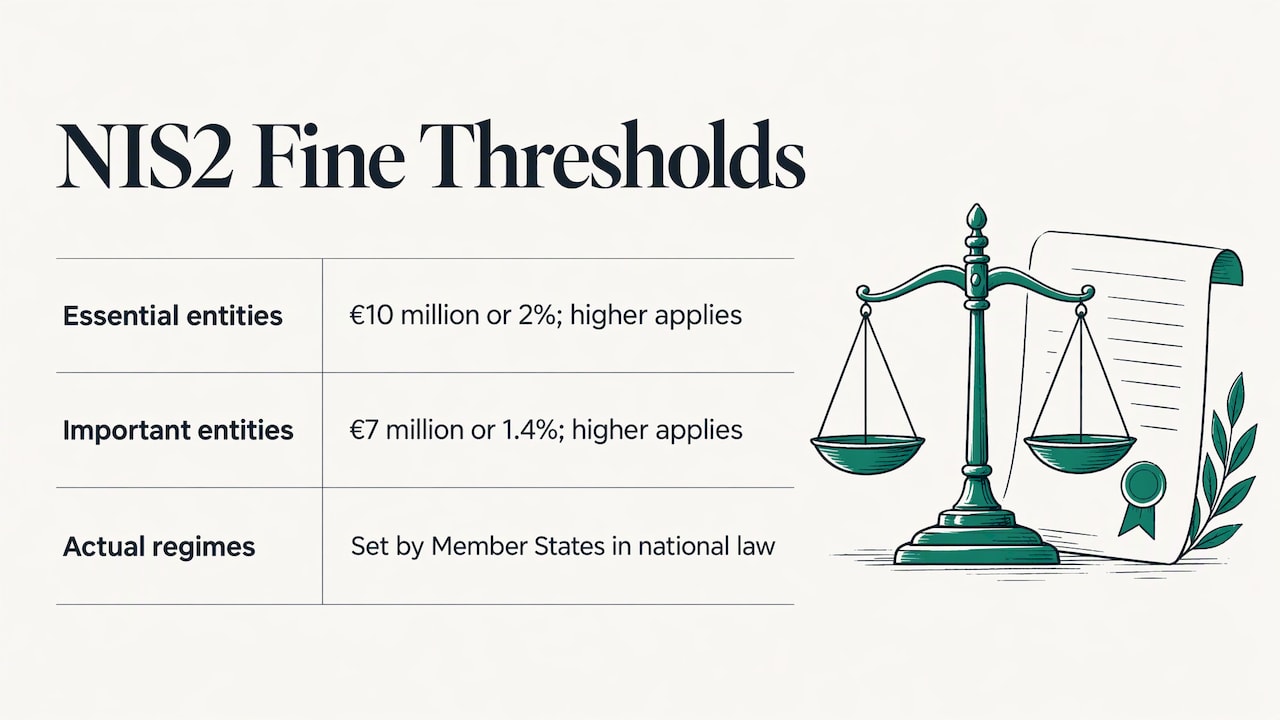
Article 34 sets the ceiling for administrative fines. For essential entities the maximum is at least €10 million or 2% of total worldwide annual turnover, whichever is higher. For important entities it is at least €7 million or 1.4%. Member States set the actual penalty regimes in national law, and the Directive’s transposition deadline was 17 October 2024 under Article 41, so check how your Member State has implemented it. All figures are in the Directive’s consolidated text.
How to document NIS2 compliance
The Directive asks for appropriate measures, so authorities and customers judge your programme through documents and evidence. A workable set looks like this:
- Scope and classification record, as described above.
- Policy set covering each Article 21(2) topic, approved by management.
- Risk register with owners, treatment decisions and review dates.
- Supplier register with risk ratings and the security terms in contracts.
- Incident procedure and log, including the 24-hour, 72-hour and one-month reporting steps.
- Evidence of operation: access reviews, backups, scans, training and test results.
- Management review minutes showing approval and oversight.
Much of this overlaps with ISO 27001. An information security management system (ISMS) built on that standard gives you a structure of policies, risk assessment, internal audit and management review that supports the Article 21 measures. If you are building one, what an ISMS is and how to run it is a good starting point. Where you also face GDPR or DORA, compliance mapping links each requirement to one control and one piece of evidence, so the same work serves every framework.
A practical route to NIS2 readiness
- Confirm scope. Check your sector against Annex I and II, your size and your Member State’s national law.
- Run a gap assessment. Compare current practice with the ten measures. Our guide to a NIS2 gap assessment shows what to check.
- Fill the gaps in risk order. Start with the topics that carry the highest risk and the shortest reporting clocks, usually incident handling and access control.
- Get management approval and training on record.
- Collect evidence continuously. Evidence gathered once a year before an audit is out of date by the time anyone reads it.
- Test. Run an incident exercise and a vulnerability assessment, and feed the results back into the risk register.
Guardiso covers several of these steps. The platform provides standards mapping, document and policy templates, risk and evidence registers, audit planning and automatic evidence collection through integrations. Ready policies are available in English and Polish, and the platform drafts documentation for the team to approve. For testing, Guardiso offers vulnerability assessments and penetration tests, and a security audit covering ISO, NIS2 and DORA. If your team lacks a security lead, the vCISO service can supply that role.
Running NIS2 in one system with Guardiso
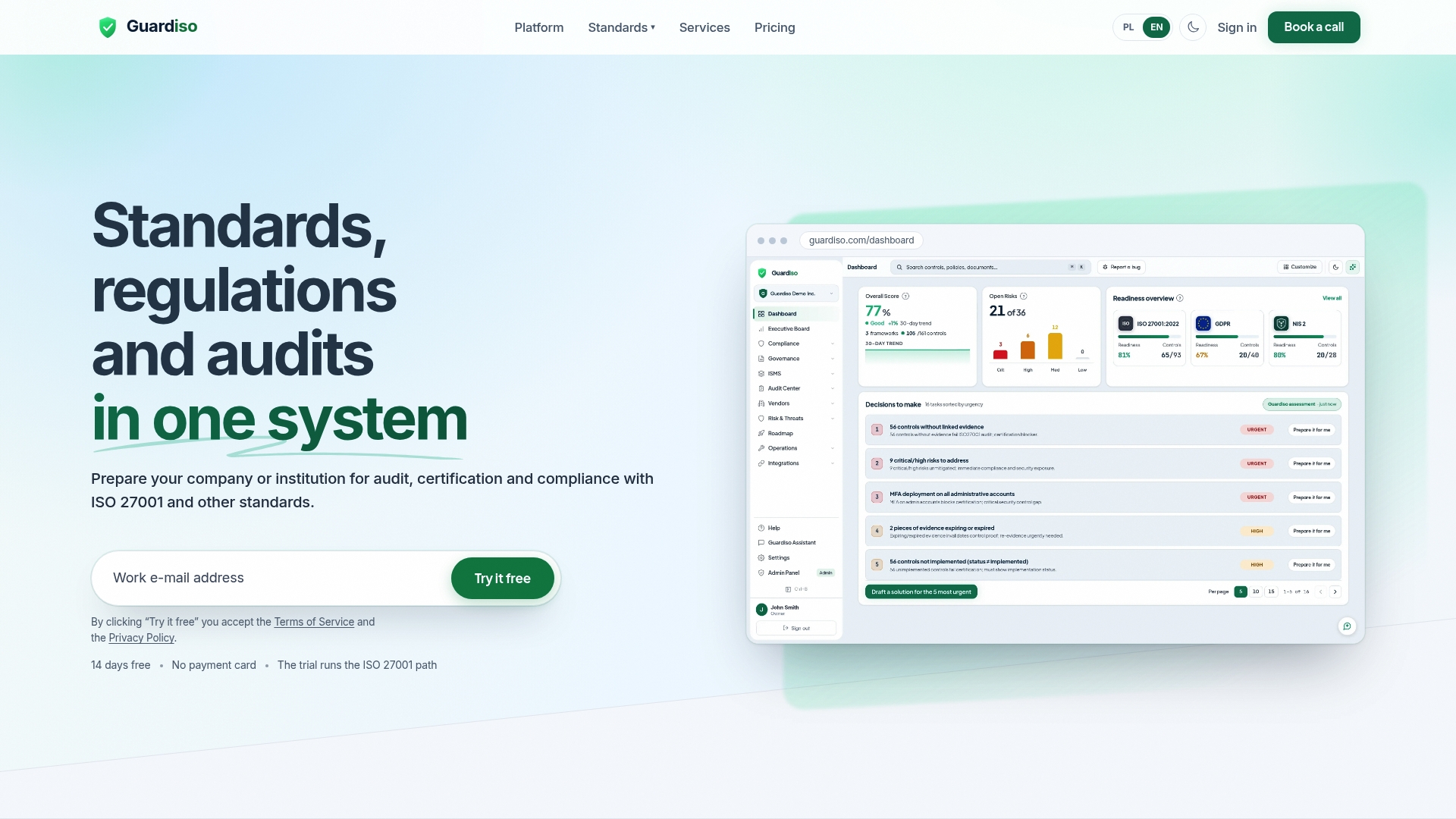
For a company in scope, the cost of NIS2 lies in repeating work: the same risk assessment for NIS2, again for ISO 27001, again for a customer questionnaire. Guardiso runs ISO 27001, GDPR, NIS2, DORA, SOC 2, ISO 22301 and about 30 other standards in one platform, so one set of documents and evidence serves many regulations. It shows compliance status, risks and open tasks, and before an audit it prepares a complete evidence pack for the auditor, who can work in an auditor portal with electronic signatures.
Plans are published on the pricing page: Starter at €199 per month and Professional at €499 per month, with Enterprise on request. Guardiso’s database and files are hosted in Poland, and Guardiso is an ISO 27001 certified company. You can read more in how Guardiso protects your data. If you are comparing tools, see how to choose NIS2 compliance software.
FAQ
Does NIS2 apply to a small company?
The general rule covers at least medium-sized entities in the listed sectors. Smaller entities can be in scope if they are a named type of provider, if a Member State designates them, or if they supply a customer that is in scope and passes its supply chain requirements down to them. Check the national law where you operate.
What is the difference between essential and important entities?
Both must meet the same Article 21 measures and Article 23 reporting duties. Essential entities are generally large Annex I entities, certain named providers and designated bodies. Other in-scope entities are important entities, and the main differences lie in supervision and the maximum fines.
How fast must a NIS2 incident be reported?
A significant incident needs an early warning within 24 hours of becoming aware of it, a notification within 72 hours and a final report within one month of the notification. Reports go to your national CSIRT or competent authority.
Does ISO 27001 make a company NIS2 compliant?
An ISMS based on ISO 27001 covers much of what Article 21 asks for, including risk assessment, policies, internal audit and management review. NIS2 adds duties of its own, such as incident reporting deadlines and management body accountability, so map the Directive’s text and your national law onto your ISMS.
Sources
- Directive (EU) 2022/2555, consolidated text on EUR-Lex
- European Commission, NIS2 Directive FAQs
- Commission Implementing Regulation (EU) 2024/2690
- ENISA, NIS2 Technical Implementation Guidance
- ENISA, Supporting NIS2 implementation through actionable guidance