
Compliance Mapping: Link Requirements to Controls and Evidence
Compliance mapping is the practice of linking every requirement you must meet to the control that satisfies it and the evidence that shows the control works. Done well, one control and one body of evidence answer ISO 27001, GDPR, NIS2 and DORA together, so your team does the work once. Guardiso, a European compliance platform with data stored in the EU, is built around this idea: one set of documents and evidence serving many regulations.
What compliance mapping means
Every framework you answer to is a list of obligations. Your company answers them with controls: a policy, a technical setting, a recurring review, a signed supplier clause. Evidence is the record that proves a control exists and runs. Mapping ties these three together in a table that you can read in either direction. Start from a requirement and see which control covers it. Start from a control and see which requirements it satisfies.
The relationship is rarely one to one. Nodrius describes how a single control can answer several requirements, while a single requirement can need several controls. That is where the saving comes from. Multi-factor authentication on privileged accounts, for example, supports an access control in ISO 27001 and the cybersecurity risk-management measures that NIS2 expects, so you implement it once and evidence it once.
You may see the same activity called regulatory compliance mapping, control mapping or standards mapping. The idea is the same: a traceable link from obligation to control to proof.
A worked example of one mapping row
Take a plain requirement: protect data at rest. A useful row looks like this.
| Element | Entry |
|---|---|
| Requirement | Cryptography and encryption policy (NIS2 Article 21(2)(h), ISO 27001 Annex A) |
| Control | Encryption enabled on all production databases, keys rotated once a year |
| Owner | Head of infrastructure |
| Evidence | Configuration export and key rotation log |
| Frequency | Evidence captured automatically each month |
| Coverage | Full |
The Modern Security Engineer Guide uses the same type of translation, from a broad requirement to a concrete control to the config and logs that prove it. A control that exists but cannot be demonstrated fails an audit.
A row like this also shows why vague mapping fails. A row that says only “Article 21” cannot be evidenced, because that article contains ten separate measures. Map at the level of the paragraph or the lettered point, and give each its own identifier that you never reuse.
Use ISO 27001 as the spine
Most mid-sized EU companies already work with, or are preparing for, ISO 27001. Its controls are broad enough to carry much of what other EU texts ask for. A practical mapping uses ISO 27001:2022 as the spine: each row is keyed by an ISO identifier, with extra columns for NIS2, DORA and GDPR. IWH describes such a unified matrix where filtering by one column produces a view for a single framework that you can export for an auditor.
An ISO control is not the same as a legal requirement, though. ISO 27001 helps you cover the ground, and each law keeps its own wording. That is why the extra columns matter.
What ISO does not cover on its own
The same IWH matrix lists the places where the legal texts go beyond ISO. These are the rows teams most often leave blank.
- Management accountability. NIS2 Article 20 and DORA Article 5 require the management body to approve and oversee the measures and make leaders answerable for them. IWH notes that NIS2 also adds mandatory training for management, which organisations often miss.
- A data protection officer. GDPR Articles 37 to 39 set out the role, which has no direct ISO 27001 counterpart.
- Records of processing. GDPR Article 30 records can draw on your ISO asset inventory, with columns added for purpose, legal basis and retention.
- Registers of suppliers. DORA requires a register of information on ICT third-party arrangements in the format the regulation prescribes, with more fields per contract than a normal ISO supplier list.
The SoSafe DORA mapping overview reaches a similar conclusion. Even with strong ISO and NIS2 coverage, three areas remain where an existing certificate falls short: the staggered incident-reporting deadlines, the minimum contract terms for providers of critical functions, and threat-led penetration testing.
Mapping NIS2 Article 21 and incident reporting
NIS2 is the EU directive on network and information security, Directive (EU) 2022/2555. Article 21(2) lists the minimum risk-management measures, among them risk analysis and information system security policies, incident handling, business continuity, supply chain security, secure acquisition and development, assessing the effectiveness of measures, basic cyber hygiene and training, cryptography, access control and asset management, and multi-factor authentication. Each lettered point deserves its own row.
The EU Publications Office has published technical implementation guidance for Commission Implementing Regulation (EU) 2024/2690. It supports the Article 21(2) measures with examples of evidence and mappings to European and international standards. It applies to the categories of digital infrastructure and service providers that regulation covers, and it is a useful model for the kind of evidence a row should name.
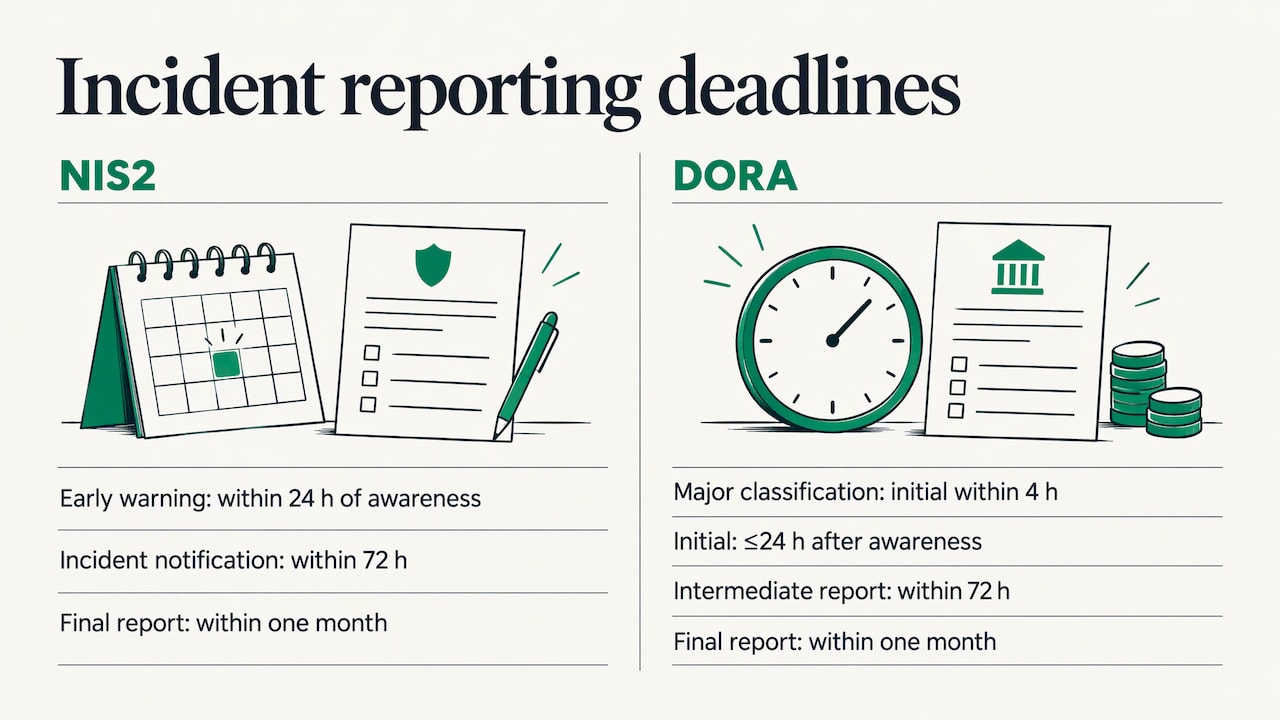
For incident reporting, the Directive’s Article 23 sets three steps for a significant incident: an early warning within 24 hours of becoming aware, an incident notification within 72 hours, and a final report within one month. Map each step to a named owner, a template and a record of who sent what and when.
DORA, Regulation (EU) 2022/2554, sets a tighter clock for financial entities. ACEN summarises it as an initial notification within 4 hours of classifying an incident as major, and no later than 24 hours after becoming aware, then an intermediate report within 72 hours and a final report within a month. ACEN also explains that NIS2 is a directive that each Member State transposes into national law, while DORA applies directly, and that for DORA entities DORA takes precedence where the two overlap. Check your national transposition when you map NIS2 rows, because details such as reporting times can differ by country. The ECSO transposition tracker follows that progress.
The European Commission’s NIS2 page also records that in January 2026 the Commission proposed targeted amendments to simplify compliance. Because the texts can move, put a review date on every legal row.
Supply chain, management and evidence for supervisors
Three themes recur across NIS2 and DORA, and each needs more than a policy document.
- Supply chain security. Keep a supplier register that records what each supplier does for you, how critical it is, the security terms in the contract and the last review. For DORA entities this feeds the register of information.
- Management accountability. Keep minutes that show the management body approved the risk strategy, along with training records and review dates. SoSafe points to management body minutes on the ICT risk strategy as evidence for DORA Article 5.
- Evidence for supervisors. A supervisor asks you to show, not tell. Name the record, its producer, how often it is produced and how long you keep it.
How to build a mapping that holds up
These steps work for a company of 10 to 250 people, and for a consultant doing the same for several clients.
- List your applicable frameworks. Confirm scope first. A company may sit under NIS2, or under DORA, or hold ISO 27001 for customers. Our NIS2 overview and DORA overview explain who is covered.
- Break each framework into rows. Use the paragraph or lettered point, with a stable identifier such as NIS2-21-2-d (instrument, article, paragraph, point). GRCide’s playbook on mapping regulation to controls recommends this and advises closing a removed obligation with a date, never renumbering.
- Derive controls from your risks. ISO 27001 clause 6.1.3 asks you to determine the controls you need from your risk treatment, then compare them with Annex A to check nothing is omitted. Our guide to the ISO 27001 risk assessment covers the preceding steps.
- Find shared controls. Group rows that one control can answer. This is where duplicated work disappears.
- Record coverage honestly. Mark each row full, partial or none. A register that never shows a gap has probably been written backwards from the answer.
- Give every gap an owner and a decision. Remediate, accept the risk with sign-off, or exclude with a stated reason. Our NIS2 gap assessment guide shows how to run the first pass.
- Design the evidence when you create the control. Define the type, source system, owner, period, frequency, retention place and what happens with exceptions. cybersecurity101.net makes the same point: evidence designed up front avoids the scramble before an audit.
- Review on a schedule. Re-check when a law is amended, when your systems change, and at least once a year.
A map supports compliance and does not replace it
A completed map shows where you have assigned controls. It does not show that each control works. A control can be listed against an obligation while it is poorly configured or no longer run. This is why the evidence column matters most. Automatic records such as configuration snapshots and logged reviews make the claim checkable, and periodic testing, internal audit and technical tests such as a vulnerability assessment confirm that the control behaves as described.
Treat “full” coverage as a status you re-earn each review period. If the evidence is out of date, change the status.
What to look for in compliance mapping software
A spreadsheet can hold a map for one framework and one team. It becomes hard to keep once you carry several frameworks, many controls and several evidence owners. When you compare tools, check these points.
| Capability | What to check |
|---|---|
| Standards coverage | ISO 27001, GDPR, NIS2 and DORA as built-in frameworks, with cross-mapping between them |
| One set of controls | A control linked to many requirements, with evidence shared across them |
| Requirement granularity | Rows at paragraph or point level, with stable identifiers |
| Evidence collection | Integrations that gather records automatically from the systems you already use |
| Gap and task tracking | Coverage status, owners, due dates and risk decisions in one view |
| Auditor access | A portal or evidence pack that an auditor can review, with signatures |
| Management reporting | A dashboard for the board that supports the accountability duty |
| Data location | Storage inside the EU and a vendor with its own security credentials |
| Document templates | Ready policies in the languages you work in |
NIS2 buyers can also use our guide on how to choose NIS2 compliance software.
Mapping for consultants with several clients
If you manage compliance for several clients, a shared structure matters even more. Keep one master set of requirement rows and one control library, then apply them per client with each client’s own owners, evidence and gap decisions. Keep client data separated, and keep a record of the review date for each client. A platform that holds several organisations and shows each one’s status and open tasks saves the weekly effort of comparing spreadsheets.
How Guardiso supports mapping
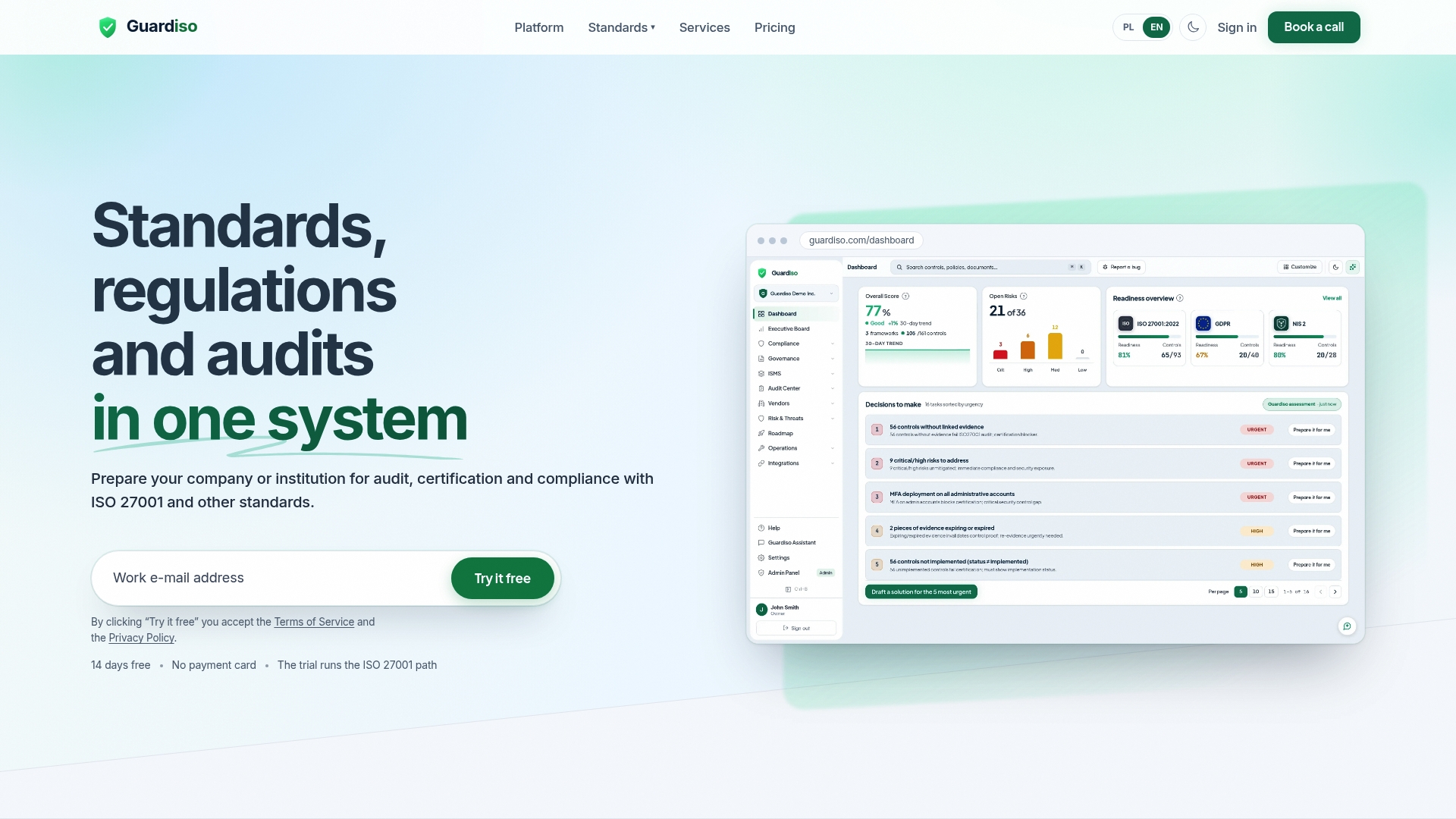
Guardiso is a platform for managing information security and regulatory compliance. In one system a company runs ISO 27001, GDPR, NIS2, DORA and its own standards, with one set of documents and evidence serving many regulations. The platform covers about 30 other standards besides, including SOC 2 and ISO 22301.
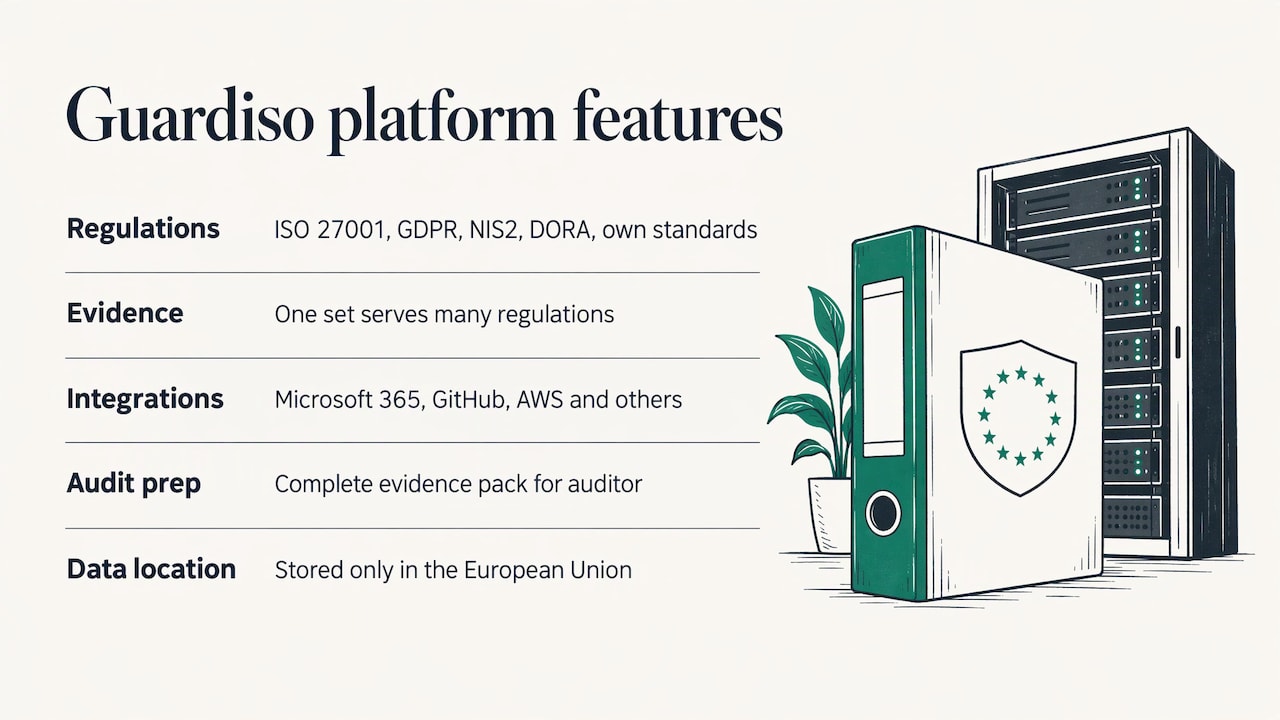
It collects evidence from Microsoft 365, GitHub, AWS and other tools through integrations, and it provides ready policies in English and Polish. It shows compliance status, risks and open tasks, and before an audit it prepares a complete evidence pack for the auditor. An auditor portal with electronic signatures, a board dashboard and a public Trust Center are part of the platform. Data is stored only in the European Union. Guardiso is an ISO 27001 certified company.
Plans are the Starter plan at €199 per month and the Professional plan at €499 per month, with Enterprise on request. See the pricing page for what each includes.
If you want technical proof alongside your map, Guardiso also offers penetration tests, audits and virtual security officer services.
FAQ
What is the difference between compliance mapping and control mapping?
They describe nearly the same work. Control mapping usually means linking the controls of one framework to those of another. Compliance mapping goes a step further and ties each legal or standards requirement to a control and to the evidence that proves it.
Does ISO 27001 certification cover NIS2 and DORA?
It covers a large part of the ground, but not all of it. NIS2 and DORA add duties such as management accountability, incident reporting deadlines and supplier registers, which need their own rows. A mapping shows exactly which ones remain.
How detailed should a mapping row be?
As detailed as the legal text allows you to evidence. Use the paragraph or lettered point of an article, and give each a stable identifier. A row against a whole article that contains many obligations cannot be proven.
Do I need software, or is a spreadsheet enough?
A spreadsheet can hold a small map for one framework. Once you carry several frameworks, shared controls and evidence from many systems, software keeps the links, owners and review dates current and prepares the pack for the auditor.
Sources
- Requirements, controls and evidence: what one row of a mapping holds, Nodrius
- Controls Mapping, Modern Security Engineer Guide
- The Unified Control Matrix: Mapping ISO 27001, NIS2, DORA, GDPR, IWH
- DORA Mapping Overview: Orientation Along the Five Pillars, SoSafe
- Directive (EU) 2022/2555 (NIS2), EUR-Lex
- Regulation (EU) 2022/2554 (DORA), EUR-Lex
- Technical implementation guidance for Implementing Regulation (EU) 2024/2690, EU Publications Office
- DORA and NIS2: Two regulations, one goal, ACEN
- NIS2 Directive Transposition Tracker, ECSO
- NIS2 Directive: securing network and information systems, European Commission
- From regulation to controls, GRCide
- Compliance Mapping, cybersecurity101.net