
vCISO services: what you get and how to buy them

A vCISO service gives a company 10 to 250 employees the leadership of a chief information security officer for the days a month it actually needs, instead of a full-time salary for a post the workload does not fill. It fits best when ISO 27001, NIS2, DORA or a customer’s security review demands a named person who owns security, and when that person works from a single system of policies, risks and evidence.
What a vCISO service is
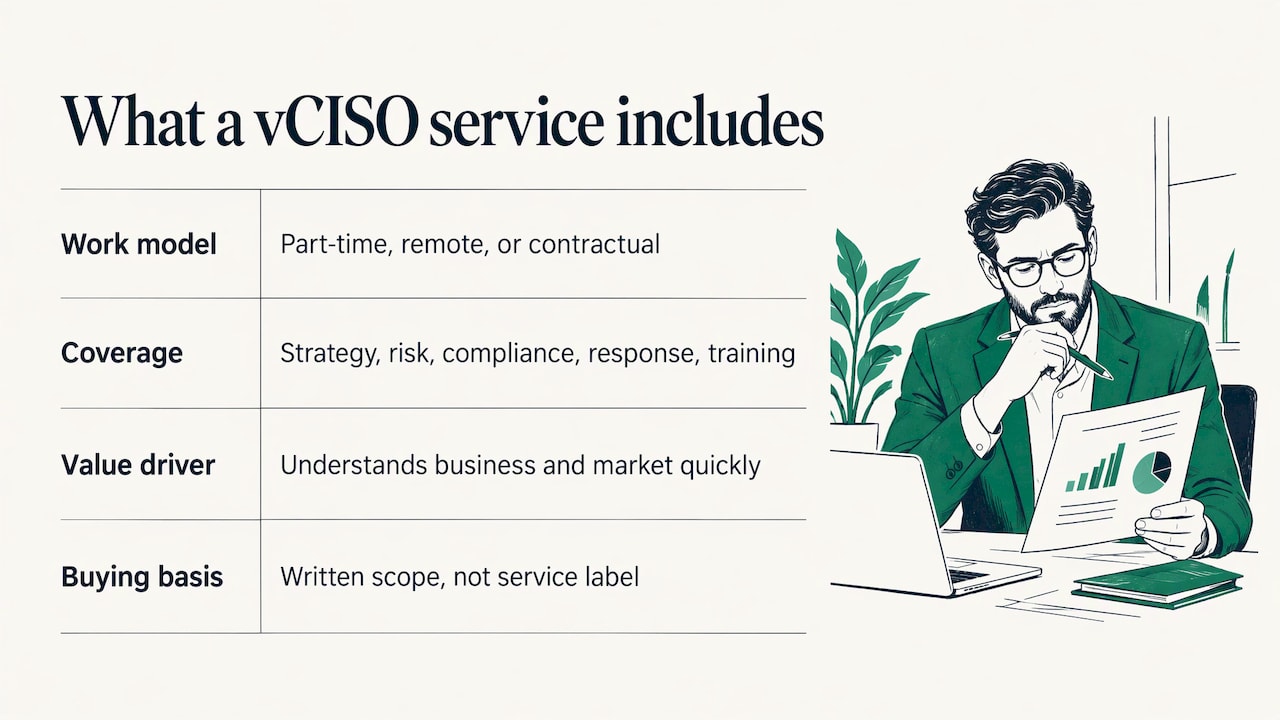
A virtual CISO is a senior security professional or service provider who offers CISO-level expertise on a part-time, remote or contractual basis. According to TechTarget, the work covers cybersecurity strategy and policies, risk assessment and management, regulatory compliance, incident response planning and security awareness training.
The ISACA Journal describes virtual CISOs as independent experts who usually work remotely, part-time and often for several clients at once. The same article makes a point worth remembering when you choose: the value of the role depends on how quickly the individual understands your business and market and adapts the security strategy to it. A vCISO who runs a generic template for every client does not deliver that.
You will also see the term CISO as a service. TechTarget’s explanation presents it as outsourcing CISO responsibilities to a third party, often on a subscription or per-use basis. In practice, buyers should look at the written scope rather than the label.
vCISO or full-time CISO
A full-time CISO works in-house and provides continuous leadership. That suits large organisations with several regulated frameworks and a security programme big enough to keep a senior person busy all week.
For a company with 10 to 250 employees the picture is usually different:
- The workload peaks around certification, a customer questionnaire, a regulatory deadline or an incident, then settles into a steady rhythm.
- A single hire carries recruitment time, training, holiday cover and the risk of choosing a generalist for a critical role.
- A vCISO brings experience from many environments, which helps when you are preparing for a certification audit for the first time.
Many growing companies treat the vCISO as the first step. Later, when the organisation becomes complex enough, they hire an internal security lead or a full-time CISO and move the vCISO into a supporting or interim role.
What a vCISO does for ISO 27001, NIS2 and DORA
The three frameworks ask different things, but the leadership work is similar: define what must be protected, decide which risks to accept, assign owners and keep proof that the controls work.
ISO 27001
ISO 27001 is the international standard for an information security management system. A company preparing for certification needs a scope, a risk assessment, a risk treatment plan, policies, internal audits and a management review. A vCISO typically leads the risk assessment, drafts or reviews the policies, plans the internal audit, briefs management and prepares the evidence an external auditor will ask for. The certification audit itself is carried out by an independent certification body, which a vCISO must not replace.
NIS2
NIS2 is the EU directive on the security of network and information systems, and it applies to essential and important entities in a range of sectors. Article 21 of the directive requires cybersecurity risk-management measures, and the measures must be appropriate and proportionate to the entity. The directive is transposed into national law by each Member State, so the details of scope and supervision depend on the country where you operate. A vCISO helps you work out whether you are in scope, turns the Article 21 measures into a plan with owners, sets up the incident escalation path and reports to management, who carry the accountability.
DORA
DORA, the Digital Operational Resilience Act, applies to EU financial entities. The Central Bank of Ireland’s FAQ explains that DORA has no transitional period and acts as lex specialis for NIS2. That means in-scope financial entities follow DORA for incident reporting and risk management, and they report to their home authority. For a vCISO this means ICT risk management, incident classification, third-party risk and a clearly identified owner of the ICT risk function who can speak to the management body.
If your company is a financial entity, check which of the two regimes applies before you scope the engagement. Guardiso’s guide to compliance regulations by industry is a good place to start.
What stays with your organisation
A vCISO does not automatically become your firewall engineer, alert analyst, incident responder, privacy officer or independent auditor. ATS notes that these tasks may sit with internal staff, another provider or separate services, while the vCISO sets priorities, connects risk to business decisions and takes material issues to decision-makers.
Responsibility for the outcome also stays with your management. As the Dutch consultancy Kynexis explains, management remains responsible for risk appetite, priorities, budget and legal obligations, and it should name an internal contract manager who follows the agreement, escalates deviations and approves risk acceptance and exceptions.
A practical split looks like this:
| Area | vCISO | Your organisation |
|---|---|---|
| Security strategy and roadmap | Proposes and maintains | Approves and funds |
| Risk register | Facilitates assessment and recommends treatment | Accepts residual risk |
| Policies | Drafts and reviews | Approves and enforces |
| Day-to-day controls | Defines what matters | IT team or managed service operates them |
| Incident response | Plans, advises and coordinates | Contains and recovers, decides who may authorise containment |
| Audit | Prepares evidence and supports the auditor | Provides records, signs off |
vCISO, consultant or managed security service
These three are often confused, and the difference decides what you should buy.
- vCISO: ongoing leadership of the security programme, with governance, risk decisions, board reporting and evidence.
- Security consultant: deep work on a defined project, such as a penetration test or a technical design. It may not own governance after the project ends.
- Managed security service: monitoring and operation of controls. It usually does not own board-level risk or regulatory evidence.
Most SMEs end up combining them: the vCISO for leadership, internal IT for execution and, where needed, a managed service for monitoring.
How engagements are scoped
Providers sell vCISO work in a few common shapes. The names vary, but the models are broadly these:
- Monthly retainer. A fixed number of days or hours each month. Best when you need continuity, for example through a certification cycle and the following year.
- Fixed programme. A set period with defined outputs, such as readiness for an audit or a gap assessment against DORA.
- Project fee. A narrow deliverable, such as a policy set or a supplier risk review.
- Hourly advisory. Occasional questions from your IT lead.
- Interim cover. A vCISO fills the role while you recruit a permanent security lead.
Smaller companies usually need fewer days than larger or heavily regulated ones. Rather than guess a number, ask the provider to estimate the days from your headcount, number of systems, number of frameworks and customer demands, and to explain how the estimate changes when a regulator or a major customer gets involved. Prices differ widely between independent practitioners, boutique firms and large advisory houses, so compare written scopes, not headline figures.
What to ask a provider
Use this list in your first conversation and again before you sign.
- Experience with your frameworks. Which ISO 27001, NIS2 or DORA engagements has the named person led, and in which sectors?
- Named person and backup. Who exactly will you work with, and who covers holidays and incidents?
- First 30 days. What will be written, reviewed or decided in that time?
- Cadence. How many days a month, which meetings, and what is the response time for urgent questions?
- Exclusions. Which tasks are not covered, for example technical testing, monitoring or privacy officer duties?
- Incident support. What happens at night or at weekends, and who may authorise containment measures such as disabling an account or isolating a device? The S2 Group advises that the agreement should say this explicitly.
- Board reporting. Is it included, how often, and in what format?
- Supplier risk. How far does supplier assessment go?
- Evidence ownership. Where are the records kept, who can access them and what do you receive if the engagement ends?
- Data handling. Where is your information stored, and under which security controls?
- Success measures. How will you both know after 90 days that the work is on track?
A useful 90-day structure is diagnosis and risk assessment in the first month, prioritisation and roadmap in the second, and first implementations in the third. Ask the provider to show you theirs.
When a vCISO makes sense
Signs that you need one:
- A customer asks for an ISO 27001 certificate or a detailed security questionnaire and nobody owns the answers.
- You fall under NIS2 or DORA and need a named accountable person.
- You are preparing for certification and the project keeps stalling between IT, legal and management.
- Your board wants one owner for security after an incident.
- A consultant managing several clients needs repeatable leadership capacity for one of them.
If you are only looking for templates to do the job yourself, a vCISO is more than you need. If you are accountable to customers or a regulator, it is a practical way to get senior judgement without a full-time hire.
How a compliance platform supports the vCISO
A large part of a vCISO’s monthly time can disappear into locating documents, reconciling spreadsheets and asking colleagues for screenshots. A compliance platform removes much of that.
With policies, risks, controls and evidence in one system, the vCISO can:
- see compliance status, risks and open tasks at a glance and decide what to tackle first;
- reuse one set of documents and evidence across ISO 27001, NIS2, DORA and GDPR rather than rebuild them for each framework;
- review drafted documentation and approve it with your team instead of starting from a blank page;
- hand the auditor a complete evidence pack at the end;
- report status to management on a board dashboard.
The benefit for you is continuity. If the vCISO changes, the records stay with you, and the work is visible to your own people between visits. Ask any provider whether they work inside a platform you control, or in their own files.
Guardiso’s vCISO service
Guardiso is an example of a provider that offers a vCISO service together with its GRC platform, so leadership and records live together. The vCISO service sits next to platform plans, and the Starter plan costs 199 € per month and the Professional plan 499 € per month. The vCISO engagement has no published price, so you scope it with the team.
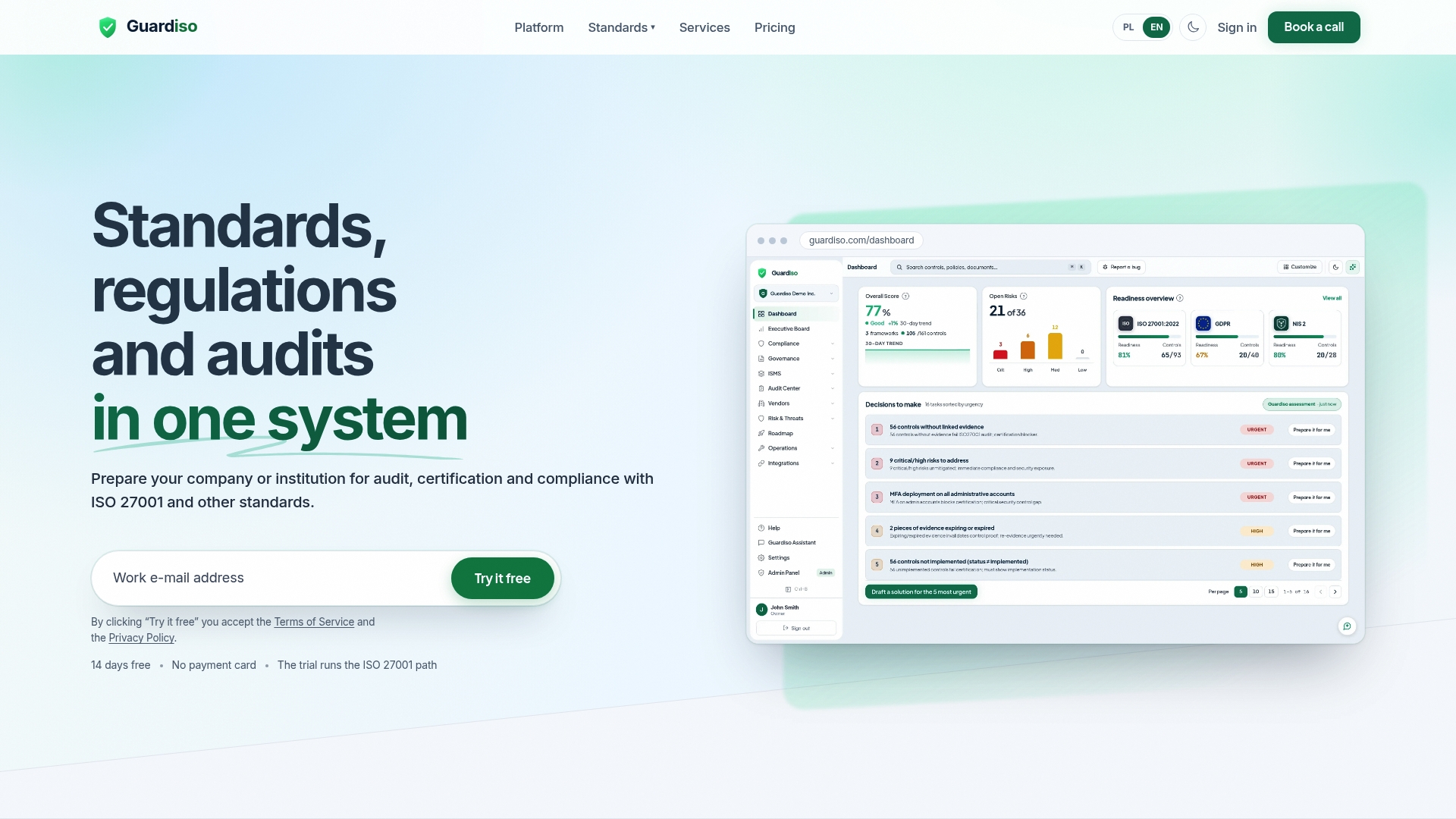
The platform covers ISO 27001, GDPR, NIS2, DORA and about 30 other standards. The database and files are hosted in Poland, and Guardiso is an ISO 27001 certified company. If your question is how a part-time officer would fit your size and your frameworks, start from the vCISO page and bring the list of questions above.
FAQ
Is a vCISO a managed service?
A vCISO is fractional security leadership, usually sold as a retainer or block of days. A managed security service operates controls such as monitoring day to day. Many companies buy both, with the vCISO setting priorities and the managed service or internal IT executing them.
Does DORA or NIS2 require a full-time CISO?
Neither text is a rule that says you must employ a full-time CISO. NIS2 Article 21 asks for appropriate and proportionate risk-management measures. DORA expects a clearly identified owner of ICT risk. Confirm the specifics with your national competent authority or legal adviser.
Can a vCISO make us certified for ISO 27001?
A vCISO can lead your preparation, from risk assessment to policies and evidence. The certificate itself is issued by an independent certification body after its audit, so the vCISO prepares you for it and does not replace it.
How many days a month will we need?
It depends on your size, systems, frameworks and customer demands. Ask the provider for a written estimate with its assumptions, and review it after the first 90 days.
Sources
- What is a virtual CISO (vCISO)? TechTarget
- What is a CISO as a service (CISOaaS)? TechTarget
- Virtual CISOs: Security Leader or Security Risk, ISACA Journal
- Directive (EU) 2022/2555 (NIS2), EUR-Lex
- DORA Frequently Asked Questions, Central Bank of Ireland
- vCISO guide, ATS
- IT outsourcing: costs, risks and checklist, Kynexis
- Managed IT services agreement responsibilities, S2 Group