
Risk Assessment Methodology: How to Choose and Run One

A risk assessment methodology is the written set of rules your organisation uses to identify, score and treat risks in the same way every time. For an EU company with 10 to 250 employees, the most practical choice is a qualitative or semi-quantitative method: a five-point likelihood scale, a five-point impact scale, defined criteria for each level, a named owner for every risk and one register that serves ISO 27001, NIS2 and DORA together. Guardiso keeps policies, risks, controls and evidence in one place, so the methodology you choose is applied once and reused across every framework.
What a risk assessment methodology has to define
The word “methodology” is often confused with a single technique. In practice it is the whole frame around the technique. A defensible methodology answers six questions in writing:
- Scope and context. Which systems, processes, locations, suppliers and legal obligations are covered?
- Risk criteria. What do “low”, “medium” and “high” mean for likelihood and for impact in your business?
- Risk appetite and tolerance. How much risk will management accept before it requires treatment?
- Identification approach. How are assets, threats and vulnerabilities found, and how often?
- Analysis and evaluation. How are scores calculated, and which scores trigger action?
- Treatment and monitoring. Who decides what to do, by when, and how is the result tracked?
The Open Group’s requirements paper for risk assessment methodologies adds a useful test. A good methodology is consistent and repeatable, so that two analysts given the same information reach similar conclusions. It also produces results that are actionable and prioritised against management’s own criteria. If your current approach fails that two analyst test, the methodology needs sharper definitions, whatever tool holds the scores.
The ten steps ENISA expects under NIS2
For organisations in scope of NIS2, the starting point is the legal text itself. Article 21(2)(a) of Directive (EU) 2022/2555 requires entities to have policies on risk analysis and information system security. ENISA’s technical implementation guidance of June 2025 turns that into a process. It asks entities to establish a risk management framework, perform and document risk assessments, and run a risk treatment plan. Residual risks must be accepted by management bodies or persons with authority to manage them.
The same guidance sets out ten steps, which you can use as a template:
- Follow a defined risk management methodology.
- Set risk tolerance in line with risk appetite.
- Maintain risk criteria.
- Identify and document risks using an all-hazards approach, including third-party risks and single points of failure.
- Analyse threat, likelihood and impact, using cyber threat intelligence.
- Evaluate risks against your criteria.
- Prioritise treatment options.
- Monitor treatment measures continuously.
- Assign responsibility and deadlines.
- Document measures in a risk treatment plan, with a justification for every residual risk you accept.
Two points deserve attention. First, the all-hazards approach means the register covers more than hackers: supplier failure, power loss, human error and physical events all belong in scope. Second, step 10 requires a written justification for accepted risks. That justification is what a supervisory authority or auditor reads first.
If you want a structured way to see where you stand against these duties, our guide to a NIS2 gap assessment shows how to run one, and the page on NIS2 requirements and scope explains who is covered.
Risk assessment methods and when each one fits
Once the frame is set, you choose how to score. The Financial Markets Intelligence guide on risk assessment methods groups techniques into six families: lookup and checklist methods, supporting methods such as interviews and what-if analysis, scenario analysis (root cause analysis, business impact analysis), functional analysis (FMEA, HAZOP), controls assessment (bow-tie) and statistical methods (Monte Carlo, Bayesian). It also states a principle worth adopting: a technique must be justifiable, produce results that improve understanding of how risk can be treated, and be traceable, repeatable and verifiable.
For information security in a company of your size, the families map to practical choices like this:
| Approach | How it scores | Best suited to | Typical limit |
|---|---|---|---|
| Checklist or control-based | Compares your controls with a list such as ISO 27001 Annex A | A first baseline, gap analysis, small teams | Shows missing controls but gives little sense of priority |
| Qualitative matrix | Likelihood and impact rated on defined levels, for example low to high | Most ISO 27001 and NIS2 programmes | Needs written level definitions to stay consistent |
| Semi-quantitative 5x5 | Numeric scales multiplied into a score from 1 to 25 | Registers with dozens of risks that need ranking | Numbers can suggest more precision than exists |
| Scenario analysis | Walks through a specific event, such as loss of a key supplier | Business continuity, DORA resilience, board discussions | Time-consuming, so use it for the top risks |
| Quantitative or statistical | Estimates frequency and financial loss | A few high-value scenarios where data exists | Needs data and skills most mid-sized firms lack |
Most organisations combine two. A semi-quantitative register covers the whole estate, while scenario analysis is applied to the five or ten risks that matter most. Our practical guide to ISO 27001 risk assessment covers how Clauses 6.1.2 and 8.2 of the standard expect you to define and apply the process.
Keeping results comparable across tools
If you work with group companies, customers or consultants who use other methods, comparability matters. ENISA’s Interoperable EU Risk Management Toolbox of February 2023 offers a reference framework for interpreting, comparing and aggregating results from different risk assessment methods. Consultants managing several clients will find it useful when each client arrives with its own scale. The EU Publications Office’s 2022 overview, Risk management standards, reviews the published standards and the methodologies and tools used to implement them.
A step by step process you can run this quarter
The ten ENISA steps can be condensed into a workflow that a team of three or four people can run. The core steps of a cybersecurity risk assessment follow the same logic: define scope, understand assets, identify risks, rate them, decide on treatment and record the outcome.
1. Fix the scope and the criteria first
Write down what is in scope and the legal drivers behind it: ISO 27001 certification, NIS2 duties, DORA obligations for a financial entity, or customer contracts. Then define your scales before anyone scores anything. A level definition should be specific enough that two people agree on it. “Likely” is vague. “Expected to occur once or more within 12 months” is a definition.
2. Build the asset and process inventory
List information assets, systems, suppliers and the business processes that depend on them. Assign an owner to each. Risks without an owner are the first to go stale.
3. Identify threats and vulnerabilities
Use the all-hazards view from ENISA’s guidance. Sources include previous incidents, supplier reviews, configuration reviews and technical testing. A vulnerability assessment or application test gives measured evidence of weaknesses, which makes likelihood scores far easier to defend.
4. Score likelihood and impact
The Open University’s risk management course describes the most common approach as two dimensions, impact and probability, shown in a matrix with a value in each cell. It warns that probability has to be related to the impact being assessed, otherwise the assessment is invalid. It also advises setting rules for how risks are recorded, for example whether you rate the most probable outcome or a severe but plausible one, and applying them consistently.
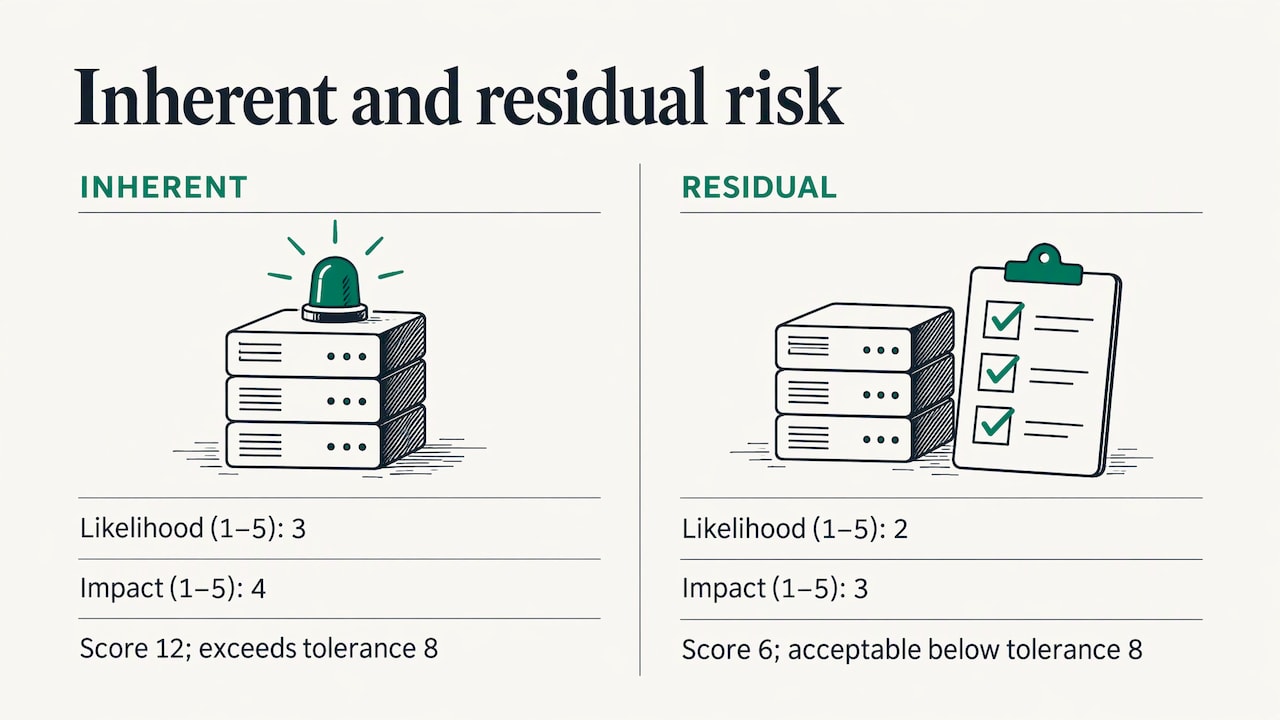
A worked illustration, using invented figures to show the arithmetic. Suppose your scale runs from 1 to 5 on both axes, and you assess the risk that a payroll supplier suffers a ransomware outage lasting a week. You rate likelihood 3 (possible within 12 months) and impact 4 (payments delayed, personal data exposure possible). The inherent score is 3 × 4 = 12. After you add contractual security requirements, a tested workaround and supplier monitoring, you rate residual likelihood 2 and residual impact 3, giving 6. If your tolerance line is 8, management can accept the residual risk and record the reason. Inherent and residual scores both belong in the register, because the gap between them shows what your controls achieve.
5. Evaluate, prioritise and decide on treatment
Compare each score with your tolerance line. For risks above it, choose one of four responses: reduce, accept, avoid or transfer. Equal scores need judgement, so add a tie-break rule such as “highest impact first”.
6. Assign owners, deadlines and a review rhythm
Every treatment action gets a named person and a date. Set a review cycle, for instance quarterly for the top risks and annually for the whole register, with an extra review after any significant incident or change.
Mistakes that weaken a risk assessment
PwC’s enterprise risk management study lists why assessments fail. Its findings translate well to security work:
- Single criterion scoring. Focusing only on financial impact misses operational, reputational and legal harm. Score impact across several dimensions.
- Scales that are too narrow. A range of 1 to 4 pushes scores towards the middle. Use at least five levels.
- Unmanageable or stale lists. A register of hundreds of unread entries protects nobody. Merge duplicates and retire closed risks.
- Treating assessment as the end. The assessment is the start of treatment, not the finish.
The Open Group adds a technical caution. Applying arithmetic to ordinal scale values can produce results that are not logical, consistent or defensible. The practical answer is to treat a 5x5 score as a ranking aid and to keep the written level definitions next to the numbers, so the reasoning stays visible.
From risk assessment to cybersecurity maturity
A risk assessment tells you what could go wrong and how badly. A maturity assessment tells you how reliably your organisation manages security in the first place. The two feed each other: weak maturity in supplier management, for example, will lift the likelihood scores for supplier risks.
ENISA’s SME Cyber Resilience Maturity Assessment Model, published in July 2026, covers five domains. It scores each criterion from 1 (none or ad hoc) to 5 (governed and continuously improved) and produces a basic, intermediate or advanced profile. Its level descriptions are a helpful template for any maturity scale:
| Level | What it looks like |
|---|---|
| 1 | None, or ad hoc |
| 3 | Practices are defined or documented but applied inconsistently across products or teams |
| 4 | Practices are applied consistently |
| 5 | Practices are proactively monitored, reviewed and improved |
ENISA also says scoring should rely on objective evidence, not assumptions or informal impressions. That principle applies to your risk register too. A score of “consistently applied” needs records behind it: approved policies, completed reviews, test results, logs. An advanced maturity score is a sign of good practice and does not by itself prove compliance with a specific law.
In practice, run the maturity assessment once a year to find which domains are weak, and run risk assessments on a rolling basis to decide what to fix first.
One methodology for ISO 27001, NIS2 and DORA
The three frameworks ask for the same core discipline. ISO 27001 requires a defined risk assessment process and a risk treatment plan. NIS2 requires risk analysis policies and, under ENISA’s guidance, documented assessments and treatment plans accepted by management. DORA applies an ICT risk management framework to financial entities. A single methodology with one set of scales, one register and one body of evidence satisfies all three, as long as you map each risk and control to every framework it supports.
That mapping is the point of using one system. When the same risk, control and evidence record answers an ISO 27001 clause, a NIS2 measure and a customer questionnaire, nobody repeats the work. For a closer look at tooling criteria, see our guide on how to choose NIS2 compliance software.
Consultants managing several clients benefit from the same approach. A shared methodology template, with client-specific criteria and appetite settings, keeps results comparable between clients while respecting each client’s tolerance.
How Guardiso supports the methodology
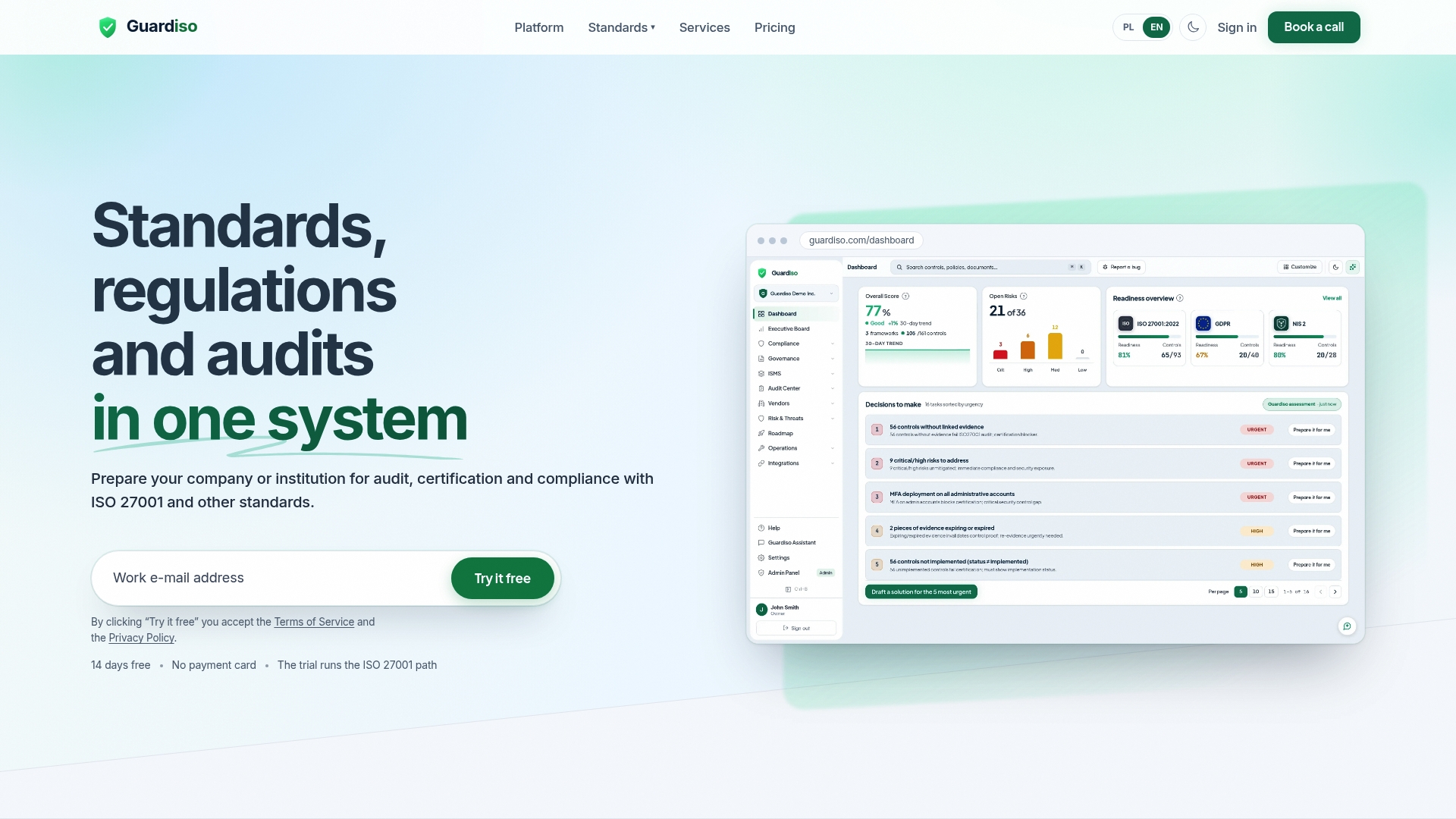
Guardiso is a platform for managing information security and regulatory compliance. Risks, controls, policies and evidence sit in one system with risk and evidence registers. The platform drafts documentation for your team to approve, and ready policies are available in English and Polish. It shows compliance status, risks and open tasks on a dashboard. Before an audit it prepares a complete evidence pack for the auditor. One set of documents and evidence serves ISO 27001, GDPR, NIS2, DORA and other standards, so adding a framework does not mean starting the assessment again.
The database and files are hosted in Poland, and Guardiso is an ISO 27001 certified company. You can read more on the security page. The Starter plan costs €199 per month and the Professional plan €499 per month, and Enterprise is priced individually. Details are on the pricing page. If you need hands-on help with scoring and priorities, a virtual security officer service is also available.
FAQ
What is the difference between a risk assessment method and a methodology?
A method is a single technique, such as a 5x5 matrix, a checklist or a bow-tie diagram. A methodology is the full procedure around it: scope, criteria, risk appetite, roles, treatment and review. Auditors and supervisory authorities look for the methodology, because it shows that scoring is repeatable.
How many levels should a risk scale have?
Use at least five. Research on enterprise risk management warns that a range as narrow as 1 to 4 makes scores cluster around the middle. Each level needs a written definition, for example a likelihood level tied to a frequency over 12 months and an impact level tied to a financial, operational or legal threshold.
How often should a risk assessment be repeated?
Review the full register at least annually and the highest risks more often, for instance quarterly. Repeat the assessment after incidents, major system changes, new suppliers or new legal obligations. ENISA’s NIS2 guidance asks for continuous monitoring of treatment measures, so the register should never be a static document.
Who has to accept residual risk under NIS2?
ENISA’s NIS2 implementation guidance states that risk assessment results and residual risks are accepted by management bodies or persons with authority to manage the risks. The acceptance and its justification should be documented in the risk treatment plan.
Do I need a separate maturity assessment?
A maturity assessment shows how consistently your security practices operate, and a risk assessment shows which risks need action. Running both gives a fuller picture. ENISA’s 2026 model for small and medium enterprises is a good reference for scoring maturity from 1 to 5.
Sources
- ENISA technical implementation guidance on cybersecurity risk management measures, June 2025
- ENISA Interoperable EU Risk Management Toolbox, February 2023
- ENISA SME Cyber Resilience Maturity Assessment Model, July 2026
- Risk management standards, EU Publications Office, 2022
- Risk Assessment Methods, Financial Markets Intelligence
- Requirements for Risk Assessment Methodologies, The Open Group
- Risk management, Session 4, OpenLearn, Open University
- How to achieve excellent enterprise risk management, PwC, 2015
- Digital duty of care risk assessment guide