
PCI DSS Assessment: Routes, Scope and Evidence
A PCI DSS assessment is the process of proving that the systems, people and processes handling payment card data meet the Payment Card Industry Data Security Standard. It ends either in a Self-Assessment Questionnaire (SAQ) or in a Report on Compliance (ROC) written by a Qualified Security Assessor (QSA), plus an Attestation of Compliance (AoC). Which route you take is decided by your acquirer or payment brand, and the work that decides whether you pass is scoping and evidence. Teams that keep policies, risks, controls and evidence in one system reach the assessment with far less rework, and that is the approach we take at Guardiso.
What a PCI DSS assessment is, and what it is not
PCI DSS is published by the PCI Security Standards Council (PCI SSC). It applies to entities that store, process or transmit cardholder data or sensitive authentication data, and to entities that can affect the security of that environment. The same source notes that the payment brands and acquirers decide who has to validate compliance. An acquirer is the bank or payment processor that lets you accept cards.
Two points follow for an EU or UK company.
First, there is no PCI DSS certificate issued by a public authority. What you hold after an assessment is a validated status: an SAQ with an attestation, or a ROC with an AoC. The QSA programme guide says the ROC must accurately represent the assessed environment and the tested controls, and that it is accompanied by an AoC summarising whether the entity is compliant. The two documents serve different purposes: the ROC is the detailed record, the AoC is what you hand to a customer, acquirer or partner.
Second, PCI DSS sits beside the EU laws you may already be preparing for. Payment-card obligations generally arise through brand and acquirer relationships, and independent European guidance stresses that PCI DSS does not replace GDPR or NIS2 duties. The frameworks have different objectives and authorities. Overlapping controls, such as access management, logging and vulnerability management, can be evidenced once, but each framework still needs its own conclusion.
Who must validate, and how often
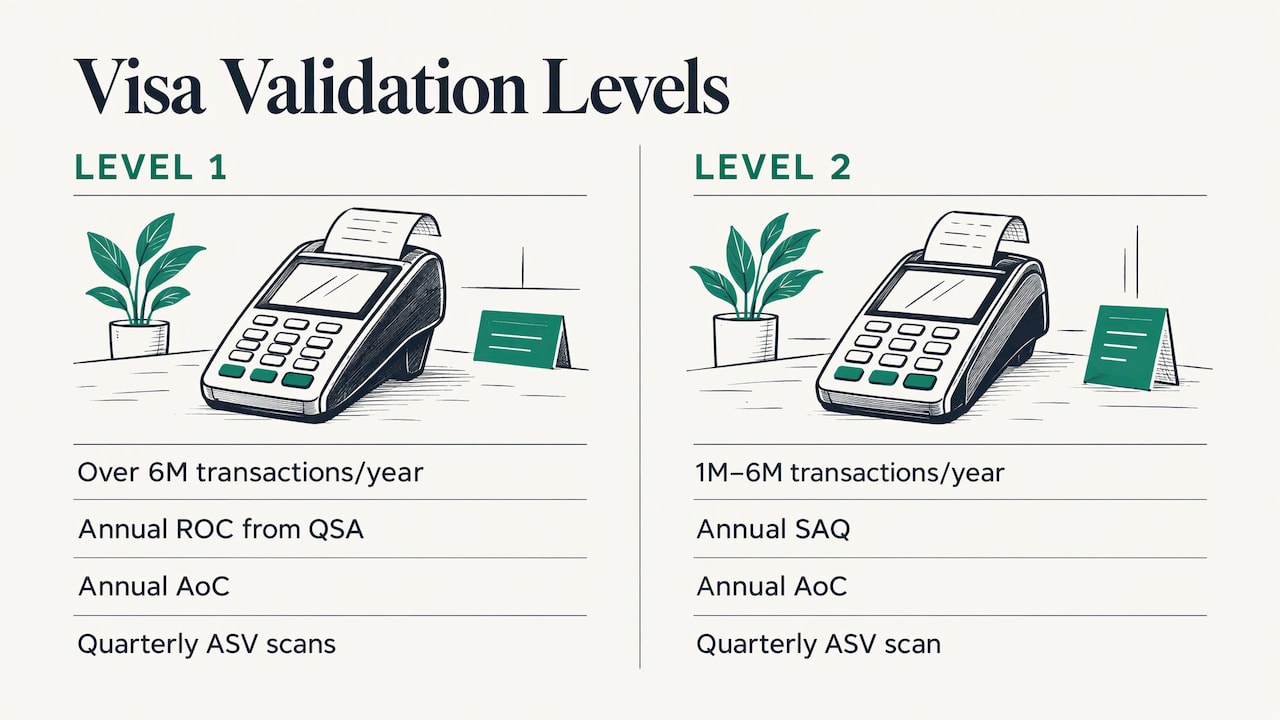
The obligation reaches you through your acquirer, and the level of validation depends on your transaction volume. Visa classifies merchants by Visa transaction count over 12 months. According to Visa’s validation guidance, Level 1 starts above 6 million transactions a year and requires an annual ROC from a QSA, an AoC and quarterly scans by an Approved Scanning Vendor (ASV). Merchants with 1 million to 6 million Visa transactions fall in Level 2, with an annual SAQ, a quarterly ASV scan and an AoC. For other tiers, acquirers can set the requirements.
For a company with 10 to 250 employees, the practical answer is usually in your merchant or service-provider agreement, or in a written request from your acquirer or a large customer. Ask which SAQ type or which report they expect, and how often. Validation is annual, and the scoping decision is confirmed every year, so treat the assessment as a yearly cycle with continuous evidence collection in between.
Choosing the route: SAQ or QSA assessment
The SAQ is described by PCI SSC as an alternate validation tool for eligible merchants and service providers. Its instructions say you must be eligible under your payment-brand programme and meet every eligibility criterion of the chosen SAQ before you begin. The document has sections for requirements, responses, and an attestation of eligibility and results.
The most common example is SAQ A. PCI SSC’s March 2025 guidance says it applies to eligible card-not-present merchants that outsource account-data functions to compliant third parties, keep only paper reports or receipts, and do not electronically store, process or transmit account data. A web shop that sends customers to a hosted payment page of a compliant provider is the typical case.
| Route | Who it fits | What you produce |
|---|---|---|
| SAQ | Eligible merchants and service providers, as allowed by the acquirer or brand | Completed questionnaire with attestation |
| ROC with AoC | Organisations required to use a QSA, such as Level 1 merchants, or those who choose it | Detailed report by the assessor and a short attestation |
Choosing a lighter SAQ than you qualify for is the most common route to a failed validation. Read the eligibility criteria line by line, and keep the reasoning on file.
Scoping the cardholder data environment
Scoping decides the size, cost and difficulty of everything that follows. The cardholder data environment (CDE) is, in the words of PCI DSS v4.0.1, the system components, people and processes that store, process or transmit cardholder data or sensitive authentication data, plus system components with unrestricted connectivity to them. The standard also covers components, people and processes that could impact the security of account data.
The same document sets out how to establish scope:
- Identify all locations and flows of account data.
- Identify all systems connected to the CDE or able to impact it, including backup and recovery sites and fail-over systems.
- Document how scope was determined and keep that record for the assessor.
- Confirm scope every year. The assessor validates it at each assessment.
If you use network segmentation to shrink scope, the segmented components must be isolated so that they cannot affect the security of account data. Segmentation that is assumed rather than tested is a frequent source of scope surprises. Our guide to penetration testing for PCI compliance covers what assessors expect when segmentation is tested.
Practical scoping tips for a mid-sized company:
- Draw a data-flow diagram that follows a card payment from the customer to the acquirer, and mark every system it touches.
- List third parties, such as payment gateways and hosting providers, and record who is responsible for which requirement.
- Include the people: support staff who can see payment screens or take card details by phone are in scope for the processes they use.
- Re-check scope after any change of provider, new checkout or new office network.
If your organisation already tracks risks and assets for ISO 27001, the asset register is a good starting point for the system inventory. For teams that track recurring checks, compliance dashboard templates show one way to lay out status and follow-up actions at a glance.
The version in force and what changed
PCI DSS v4.0.1 is the current version. PCI SSC states that it became the only active version after v3.2.1 retired on 31 March 2024. The same source says 51 future-dated v4.x requirements became effective on 31 March 2025 and must be considered in assessments. Any old checklist built on v3.2.1 or on the early v4.0 timeline is therefore out of date. Check that your SAQ form or assessor template is the v4.0.1 edition.
What the assessor does and what you must prepare
In a QSA assessment the sequence is the same each year. The assessor confirms scope, then examines evidence, observes processes and controls, and interviews staff. Results are recorded in the ROC or SAQ, and the AoC summarises whether you are compliant. Gaps are remediated and then reassessed. AKATI’s description of a v4.0.1 audit follows this order.
What that means in preparation:
- Policies and procedures. Current, approved, owned by a named person and reviewed on a schedule.
- Configuration evidence. Firewall rules, system hardening, access lists and logging settings, with dates.
- Process evidence. Access reviews, change approvals, vulnerability scan results, incident response exercises and staff training records.
- Testing evidence. Quarterly ASV scans where required and penetration test reports covering the CDE and any segmentation.
- Third-party evidence. The compliance status of every service provider that touches card data.
Most delays come from evidence scattered across email, shared drives and tickets. Evidence also goes stale: a screenshot taken eight months before the audit is not proof of how a control works today.
Where Guardiso takes work off your hands
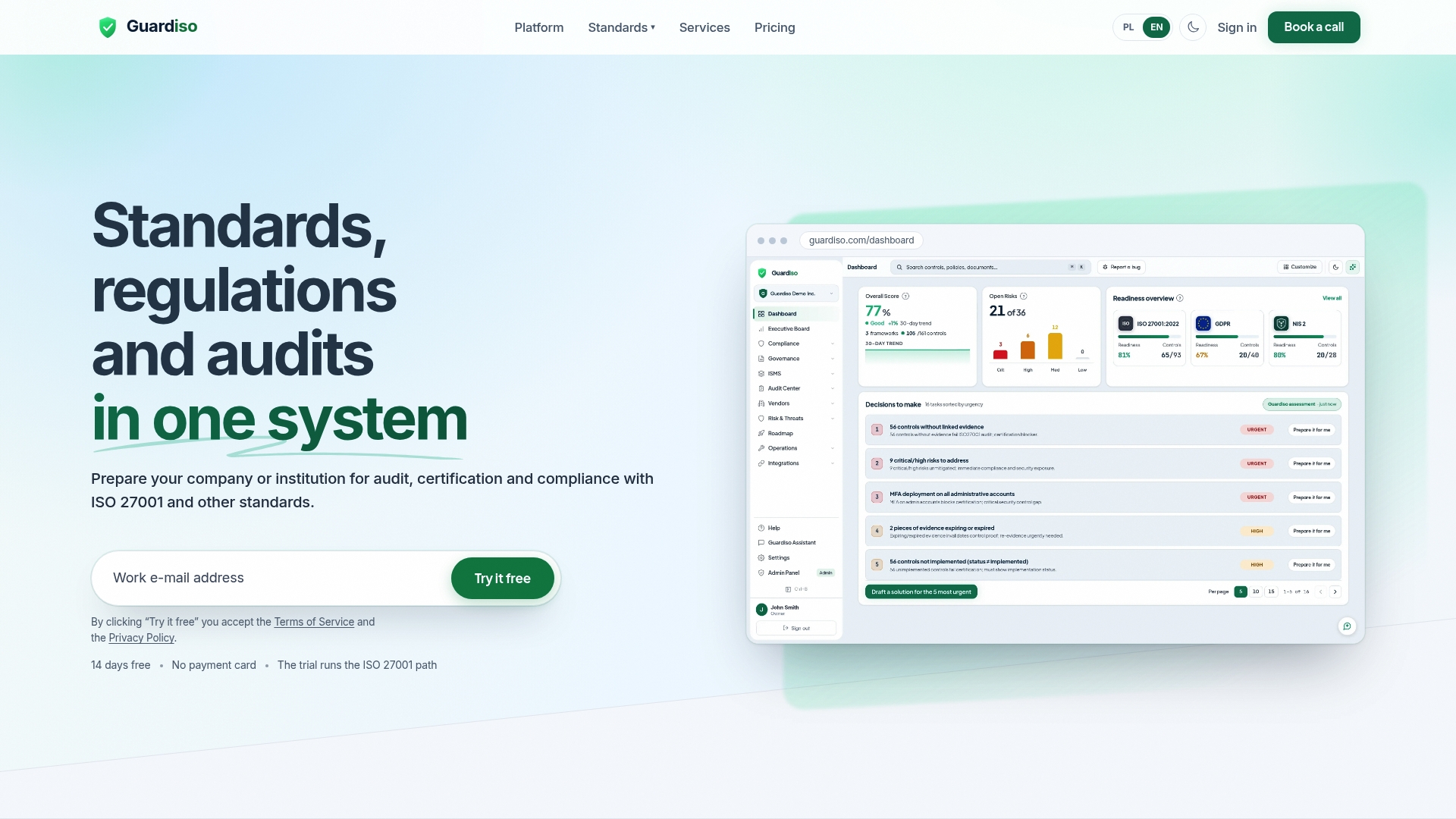
Guardiso is a platform where policies, risks, controls and evidence live in one place. It drafts documentation for your team to approve, collects evidence automatically through integrations, and before an audit it prepares a complete evidence pack for the auditor. An auditor portal with electronic signatures keeps requests and approvals in one trail, and the audit planning module lets you schedule control checks through the year. Because one set of documents and evidence serves many standards, the access control policy you write for PCI DSS also supports ISO 27001, NIS2 or DORA. You can read how the standard is covered on our PCI DSS page and see the integrations and evidence features.
The testing part can be handled too. We offer external and internal penetration tests and security audits, and web application, API and mobile application tests that produce reports your assessor can use as evidence.
Costs
No single figure fits. Adyen’s PCI DSS guide says costs vary by business size, transaction volume and security measures. Four items drive the budget: the QSA fee if you need a ROC, ASV scanning, penetration testing, and the internal hours spent on evidence. Scope reduction is the strongest lever. A hosted payment page that qualifies you for SAQ A removes most systems from the assessment altogether.
The internal time is the cost companies underestimate. A platform subscription turns it into a predictable line. Guardiso’s published plans are Starter at 199 € per month and Professional at 499 € per month, and Enterprise is priced individually. Details are on the pricing page.
Verifying a supplier’s PCI DSS compliance
If you are the customer, ask for the supplier’s current AoC and check who produced the assessment. PCI SSC defines a QSA company as an independent security organisation qualified to assess PCI DSS adherence. According to its QSA page, qualification is renewed annually and is not an endorsement of the assessor’s services. The Council advises checking its current QSA listing because status can change. Check the AoC date, the scope it covers and the version of the standard.
If you are the supplier, a ready AoC and a clear scope statement shorten customer due diligence. A public Trust Center and a shared security portal let you give partners your compliance status without sending documents by email.
Putting PCI DSS next to other frameworks
Many EU companies face several demands at once: a customer asking for PCI DSS, a regulator for NIS2 or DORA, a tender requiring ISO 27001. The controls overlap, so mapping them once avoids duplicated effort. Our overview of compliance regulations by industry shows what typically applies to which sector. If a senior owner is missing for the programme, a part-time security officer can take responsibility for scope, evidence and the assessor relationship.
We are an ISO 27001 certified company, and our database and files are hosted in Poland. Details of how we protect your data are on our security page.
One system for the whole assessment cycle
If you are preparing for a PCI DSS assessment alongside other frameworks, Guardiso covers the cycle from implementation to the auditor’s evidence pack in one platform, with ready policies in English and Polish and standards mapping across ISO 27001, GDPR, NIS2, DORA, SOC 2 and about 30 other standards.
See the plans on the pricing page or start from the Guardiso homepage.
FAQ
Is PCI DSS compliance a certification?
No public body issues a PCI DSS certificate. Compliance is validated through an SAQ with an attestation, or through a ROC with an AoC produced by a QSA. Your acquirer or payment brand decides which applies.
How often is a PCI DSS assessment required?
Validation is annual, and scope is confirmed every year. Visa’s Level 1 merchants also need quarterly ASV scans, and Level 2 merchants complete an SAQ, quarterly scans and an AoC each year. Ask your acquirer for the schedule that applies to you.
What is the difference between a ROC and an AoC?
The ROC is the assessor’s evidence-based report on the assessed environment and the controls tested. The AoC is the short attestation that states whether the entity is compliant. Customers and acquirers usually ask for the AoC.
Which PCI DSS version applies today?
Version 4.0.1 is the only active version. All its requirements, including the 51 that were future-dated, have applied since 31 March 2025.
Sources
- Payment Card Industry Data Security Standard v4.0.1 (applicability and validation)
- Payment Card Industry Data Security Standard v4.0.1 (scope and CDE)
- Qualified Security Assessors programme guide, PCI SSC
- Visa: validation of compliance
- PCI SSC: SAQ instructions and guidelines
- PCI SSC blog: guidance for e-commerce requirements after 31 March 2025
- PCI SSC: Qualified Security Assessors
- PCI DSS 4.0.1 : exigences et conformité en entreprise
- Adyen: what is PCI DSS
- Inside a PCI DSS 4.0.1 audit