
Control Mapping: How to Map ISO 27001 Controls Once and Reuse Them
Control mapping means linking each security control you operate to the risks it treats, the policies that describe it, the evidence that proves it and every standard or regulation that asks for it. Done once and kept current, one map serves ISO 27001, GDPR, NIST-style frameworks and sector rules, so your team stops answering the same question in a new spreadsheet for every customer and auditor. Guardiso is a platform that runs ISO 27001, GDPR, NIS2 and DORA in one system, with one set of documents and evidence serving many regulations. This guide explains how to build the map by hand first, and where it pays to move it into a system.
What control mapping means
A security control is a measure that reduces a risk: a rule that access is reviewed quarterly, an encrypted laptop policy, a supplier checklist. Frameworks describe similar measures in different words and different numbering. Control mapping links them to a common reference. TechTarget describes a structured map as a way to reduce duplication and provide audit evidence.
For a company with 10 to 250 employees the pressure is usually practical. A customer sends a security questionnaire. An NIS2 or DORA obligation arrives. A second certification is planned. Without a map, each of these starts a new document hunt. With one, the answer to “how do you manage access rights?” is one control, one policy and one evidence set, referenced from every framework that asks.
ISO 27001 controls, Annex A and control objectives
ISO 27001 has two layers. The main clauses (4 to 10) describe the management system: context, leadership, risk assessment, risk treatment, internal audit and improvement. Annex A is a catalogue of controls. NQA’s implementation guide states that the 2022 edition of Annex A contains 93 controls.
The older 2013 edition grouped controls under objectives. The 2022 edition groups them into four themes: organisational, people, physical and technological. If you still see the phrase “control objectives”, it refers to the purpose each control serves, which in the current text sits at the start of each control description.
The point that shapes the whole mapping exercise: Annex A is not a mandatory checklist. An ISO/IEC JTC 1/SC 27 auditing practices note describes Annex A as a common reference set rather than a complete or universally required list. Organisations may design their own controls or take them from other sources such as ISO/IEC 27017 or NIST. NQA explains that controls are selected through the risk process, and that you may use controls from outside Annex A when your risks call for them.
Why the map is many-to-many
Beginners expect a neat table in which control A equals requirement B. Real maps do not work like that.
The UK Government’s mapping of its cyber governance code to ISO/IEC 27001:2022 shows it. Senior ownership and integration of cyber risk map to Clause 5.3 and Clause 6, while regular risk assessment maps to Clauses 6, 8.2 and 9.1. One governance action touches several clauses.
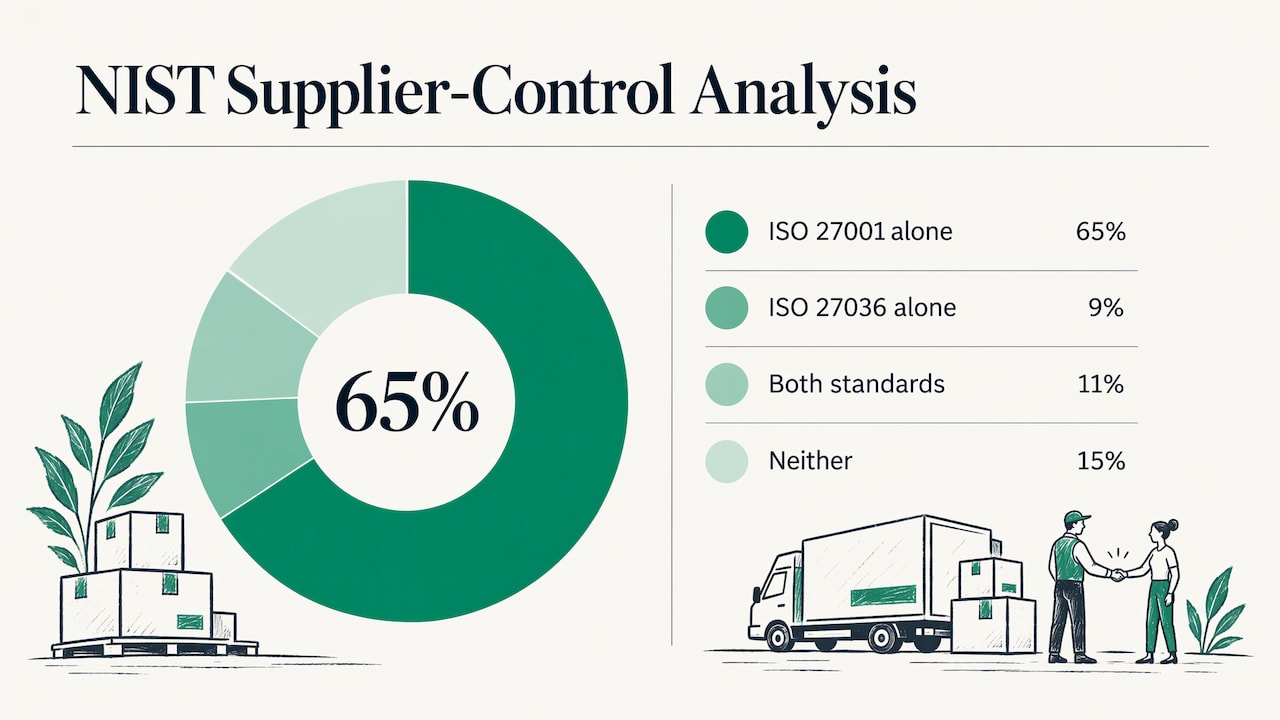
The relationship also runs the other way. In a 2024 NIST cross-walk presentation, some supply-chain controls were addressed by a basket of ISO controls, and others needed ISO/IEC 27001 combined with ISO/IEC 27036-2. For one specific NIST supplier-control analysis, 65% of the individual controls could be accounted for through ISO/IEC 27001 alone, 9% through ISO/IEC 27036 alone, 11% only by combining both and 15% by neither. Those percentages belong to that analysis and not to every framework pair, but the lesson carries: expect partial overlaps, and record them as partial.
Build the map in six steps
1. Define the scope and the frameworks
Write down which parts of the business are in scope and which frameworks you must answer to. A typical set for an EU company is ISO 27001 as the backbone, GDPR for personal data, plus NIS2 if you are an essential or important entity, or DORA if you are a financial entity or an ICT provider to one. Keep the list short at the start. Each extra framework multiplies the review work.
Where it goes wrong: scoping by organisation chart instead of by information flows. A system that processes customer data but sits outside the scope statement will surface in the first customer audit.
2. Run the risk assessment first
The risk assessment decides which controls you need. Clause 6.1.3© requires you to compare the controls you determined through risk treatment with Annex A and verify that no necessary control was omitted, as the SC 27 practice note explains. The order matters: risks first, controls second, Annex A comparison third. Our guide to ISO 27001 risk assessment under Clauses 6.1.2 and 8.2 walks through the method.
Where it goes wrong: starting from the 93 controls and working backwards to invent risks. The result is a map that looks complete and describes nothing real.
3. Decide which controls apply
For every Annex A control, decide whether it applies. The committee’s note on Annex A lists the accepted reasons for excluding one: there is no related risk, the risk is acceptable given related controls and interested parties, or another control replaces it. Inclusion should likewise be justified by your context and risk arrangements, not by the fact that the control sits in Annex A.
Write the justification in a sentence while the reasoning is fresh. Reconstructing it a year later, before an audit, is far harder.
4. Link each control to a policy, an owner and evidence
This is the step that makes the map useful. For each applicable control record:
- the policy or procedure that describes it;
- the named owner;
- the evidence that it operates, such as an access review export, a training record or a configuration screenshot;
- how often the evidence is refreshed.
Where it goes wrong: pointing to a policy as if it were evidence. A policy shows intent. Auditors and customers also want proof that the control ran.
5. Cross-reference other frameworks
Now add columns for each further framework and mark which of its requirements the control satisfies, fully or partly. NIST’s OLIR programme catalogues informative references, including ISO/IEC 27001:2022 to NIST CSF mappings, and states that they support cross-referencing and do not establish automatic compliance. Published mappings are a good starting point, but check each line against how your own control works.
For reference, our pages on ISO 27701 and NIST 800-53 show how those frameworks relate to an ISO 27001 programme.
6. Review on a schedule
A map is stale the moment a system, supplier or owner changes. Set a review rhythm, tie it to your internal audit and management review, and update the map whenever the risk assessment changes.
What the register should contain
The SC 27 note says the Statement of Applicability should document the necessary controls, why they are necessary, their implementation status, and why reference controls are considered unnecessary. The standard does not prescribe a layout. A practical register for a mid-sized company has these columns:
| Column | What it holds |
|---|---|
| Control ID | Annex A reference or your own control number |
| Applicable | Yes or no |
| Justification | The risk it treats, or the reason it is excluded |
| Status | Implemented, partly implemented, planned |
| Linked risks | Risk register identifiers |
| Policy | Document name and version |
| Owner | A named person |
| Evidence | Link or reference, with last refresh date |
| Other frameworks | NIS2, DORA, GDPR and customer requirements covered |
This is the same structure whether you keep it in a spreadsheet or a system. The difference appears at maintenance time. Nine columns across 93 controls and several frameworks means hundreds of cross-references that must stay consistent when a document is renamed or an owner leaves.
Common mistakes
Treating Annex A as the whole requirement. The committee note calls Annex A a quality check against omissions in risk treatment, not a replacement for risk assessment.
Forcing one-to-one matches. If a control covers half of a requirement, mark it as partial and name what fills the other half.
Copying a published crosswalk without review. The UK Government mapping describes itself as an illustrative reference point. It is not authoritative and not legal advice on compliance.
Mapping without evidence. A column of green ticks with no evidence behind it fails at the first sample request.
Letting it age. A map that matched your environment two years ago may describe suppliers you no longer use.
Using the map for audits and customer assurance
A well-kept map shortens audit preparation because the auditor’s sampling questions land on controls that already have an owner and evidence attached. It also speeds up customer questionnaires: most questions can be answered by pointing to an existing control.
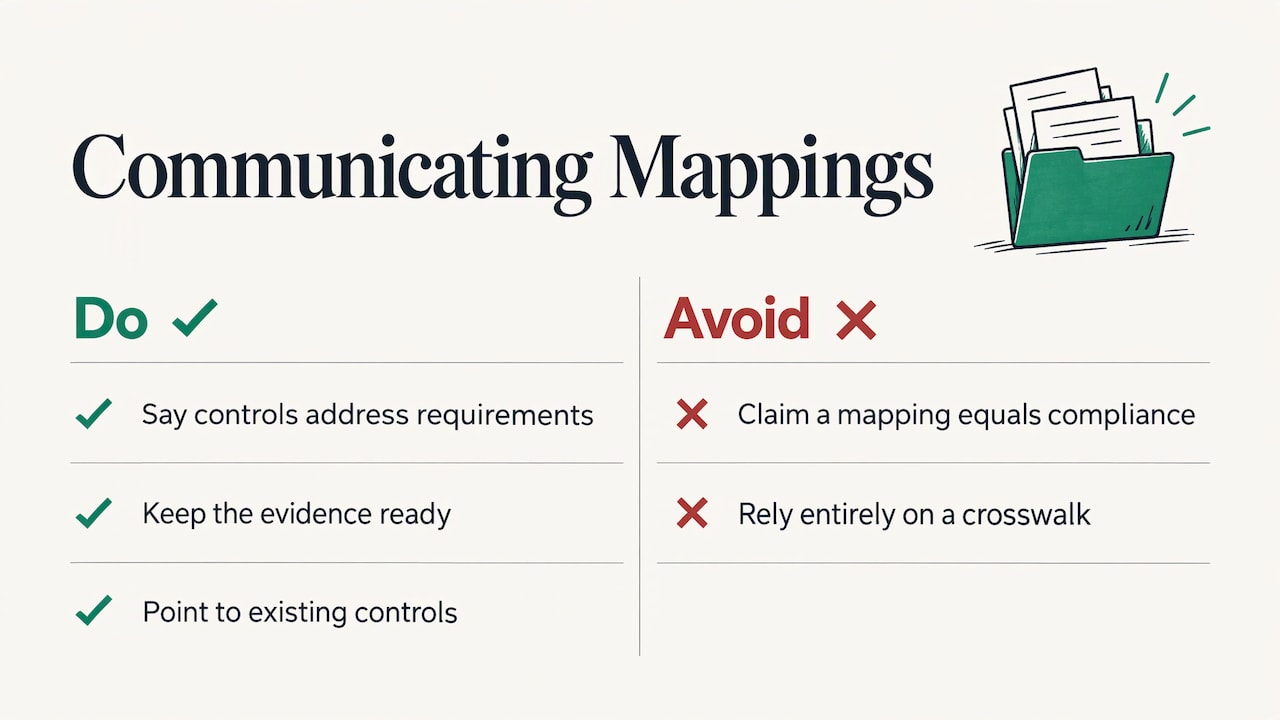
Keep its status clear. Mappings are informative. Even NIST’s own HIPAA crosswalk says they do not imply or guarantee compliance, and that organisations must perform their own risk analysis and cannot rely entirely on a crosswalk. In your own communication, say “our controls address these requirements” and keep the evidence ready, rather than claiming that a mapping equals compliance. For regulated obligations such as NIS2 or DORA, take the legal reading from the official text or your legal adviser.
Where a platform helps
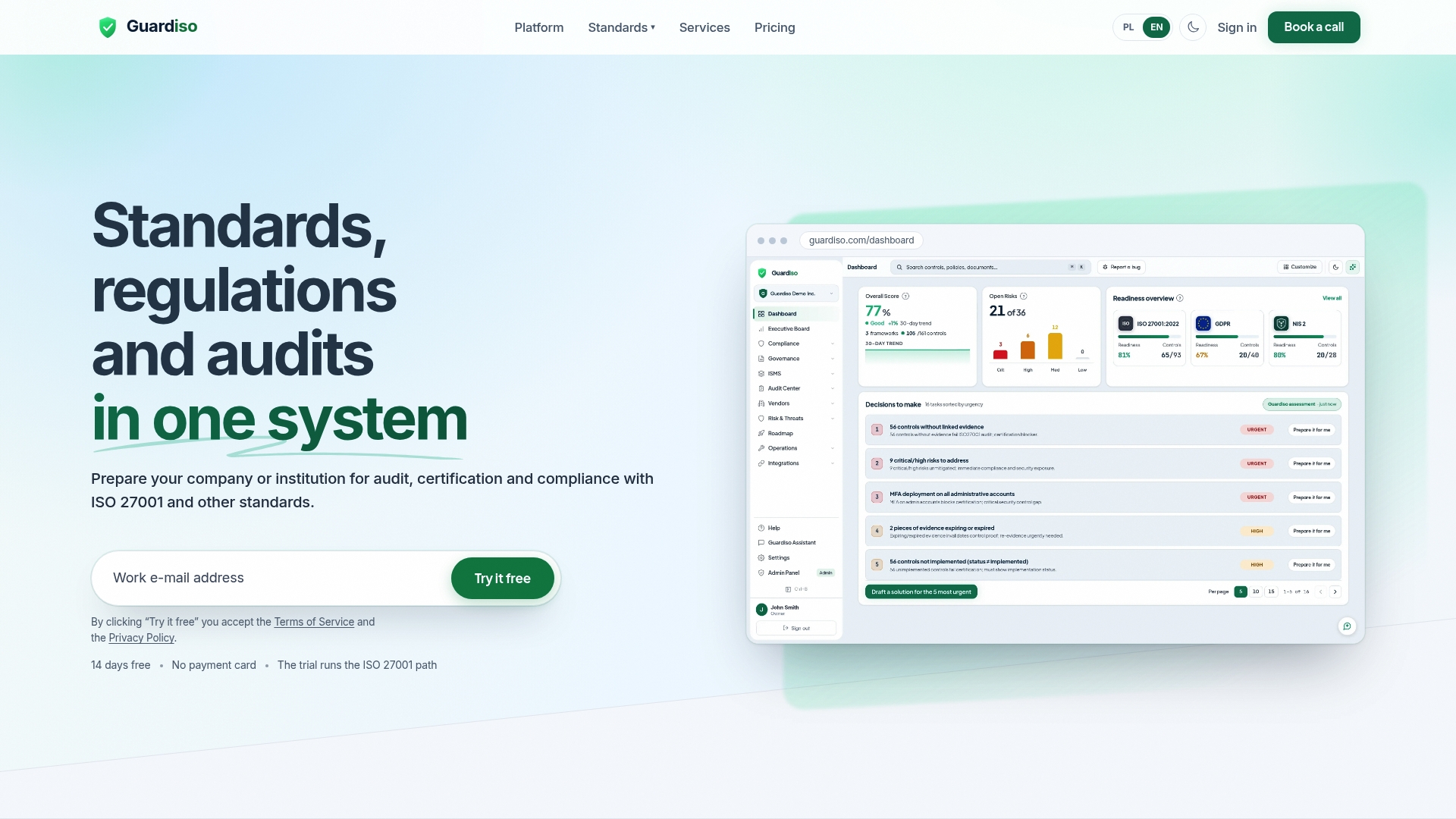
A spreadsheet map works for one framework and a handful of people. It strains when you add NIS2 or DORA, or when you manage several clients as a consultant. Guardiso keeps ISO 27001, GDPR, NIS2, DORA, SOC 2, ISO 22301 and about 30 other standards in one system, with standards mapping, document and policy templates, risk and evidence registers and audit planning. It collects evidence automatically through integrations such as Microsoft 365, GitHub and AWS, and before an audit it prepares an evidence pack for the auditor. Data is stored only in the European Union, and Guardiso is an ISO 27001 certified company.
The Starter plan costs €199 per month and Professional costs €499 per month. Enterprise is priced individually. See the plans and pricing. If you are choosing tooling for certification, our guide to ISO 27001 software lists the criteria, and the free ISO 27001 readiness test shows where your controls stand today. For hands-on help with an audit or a security officer role, see the vCISO service.
FAQ
How many controls are in ISO 27001 Annex A?
The 2022 edition of Annex A contains 93 controls, according to NQA’s implementation guide. You consider all of them during risk treatment, then select those your risks require and justify each one in the Statement of Applicability.
Do I have to implement every Annex A control?
No. Controls are options selected through your risk process. You can exclude a control where there is no related risk, where the risk is acceptable, or where another control replaces it, and you record the reason. You may also add controls from outside Annex A.
What is the difference between a control map and a Statement of Applicability?
The Statement of Applicability is the ISO 27001 document listing your necessary controls, why they are necessary, their status and why reference controls are excluded. A control map is broader: it also links controls to risks, evidence and other frameworks. Many companies build the Statement of Applicability as the core of the map.
Can a mapping prove I comply with another framework?
It cannot. Published mappings are informative references, and the organisations that publish them say so. Use them to find overlaps, then confirm each against your own controls and evidence. The ISO 27001 overview explains what certification itself involves.
Sources
- How mapping security controls can ease the compliance burden (TechTarget)
- ISO/IEC JTC 1/SC 27/WG 1 N 3298, Auditing Practices Note on the Statement of Applicability
- ISO/IEC JTC 1/SC 27/WG 1 N 3297, Auditing Practices Note on Annex A
- NQA ISO 27001:2022 Information Security Implementation Guide
- UK Government: Mapping cyber governance code to ISO/IEC 27001:2022
- NIST: Standards-based Approach to Advancing Information Security (2024 presentation)
- NIST: National Online Informative References Program