
Audit Readiness: How to Be Ready for Your Next Compliance Audit
Audit readiness means you can show an auditor, at any moment, which requirements apply to you, which controls meet them, who owns each control and where the current evidence sits. It is a condition you maintain all year. It is not a folder you assemble after the notice arrives. For a company that runs ISO 27001, NIS2, DORA and GDPR side by side, the practical route is one register of requirements, controls and evidence that serves every framework, kept up to date by the people who run the controls. Guardiso is built around that idea, and the rest of this article shows how to do it.
What audit readiness means
The phrase is used loosely. Financial teams use it for year-end ledgers, while security and compliance teams use it for something broader. In a compliance setting, a company is ready when it can do five things:
- Identify the requirements that apply to it.
- Show that the controls meeting them are implemented.
- Name the person responsible for each control.
- Retrieve current evidence quickly.
- Show that weaknesses are tracked through corrective action and retesting.
That list follows a description of compliance audit readiness which treats readiness as an operating condition and a document hunt after notice as the thing to avoid.
The auditor’s side matters too. ENISA, the EU Agency for Cybersecurity, says in its 2025 technical implementation guidance that independent reviews should be carried out by people with suitable competence in cybersecurity, risk assessment, compliance, regulation and auditing. It also says conformance and compliance conclusions must be documented. A claim that a framework has been implemented is therefore the start of the conversation. The auditor will want to see how you reached that conclusion.
Why readiness is now a continuing job
Two things push EU companies from occasional audits to constant readiness.
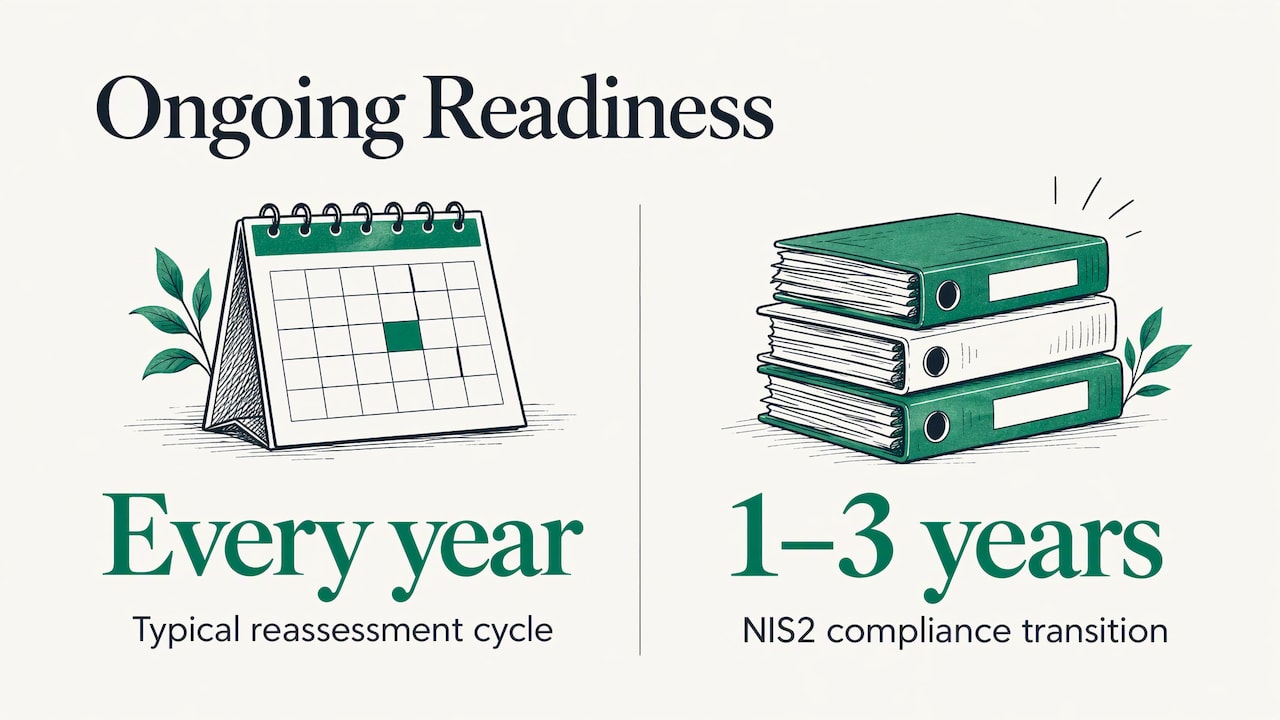
The first is repetition. ENISA’s guidance on auditing security measures describes periodic reassessment of certified information security management systems, commonly every year, by competent certification bodies. If an ISO 27001 certificate is reviewed each year, the evidence has to exist each year.
The second is the number of frameworks. A mid-sized supplier may answer to ISO 27001 for customers, GDPR for personal data, NIS2 as an operator in scope and DORA as a provider to financial entities. BSI Group’s NIS2 mapping tool uses ISO/IEC 27001:2022 Annex A as a practical starting point for mapping NIS2 measures. It also notes that the move to NIS2 compliance often takes one to three years, so essential measures need an early start. In short, work done once for ISO 27001 carries over to the other frameworks when it is mapped properly.
A preparation routine in seven steps
The order below follows the European Commission’s good practice on general preparation for an audit and the readiness description cited above. Each step shows where it usually goes wrong and, where relevant, what Guardiso does.
1. Fix the scope, objective and criteria
The Commission’s guidance says to establish scope, objective and criteria before fieldwork, including the geographical, documentary, temporal and material boundaries. For a company this means answering four questions in writing: which sites, which systems and processes, which period, and against which standard or regulation.
The usual failure is a scope that is too wide, or one that differs between documents. An ISO 27001 scope statement that names one office while the risk register covers three is an easy finding. Guardiso holds the standards you select, such as ISO 27001, NIS2, DORA, SOC 2 or ISO 22301, in one system, so the criteria for each audit are listed in one place.
2. Map requirements and name control owners
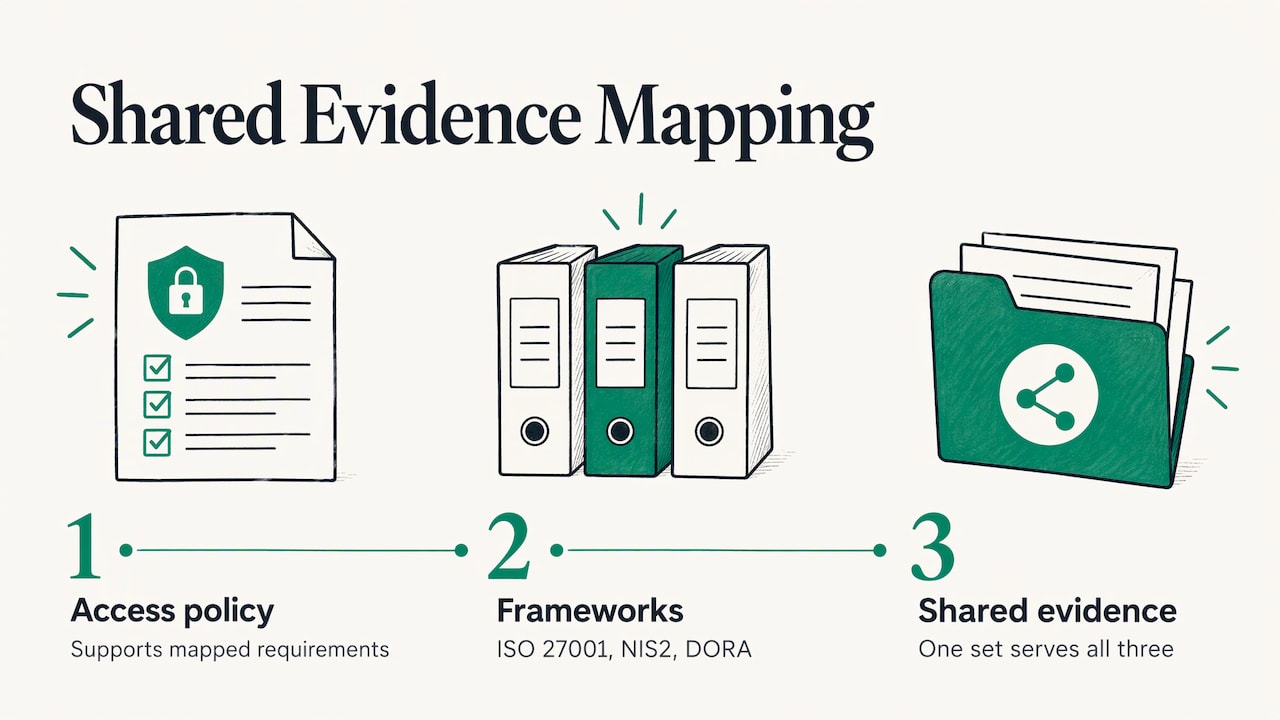
List each requirement of the framework, link it to the control that meets it and give that control one owner. Overlap is where time is saved: one access control policy can support an ISO 27001 control, a NIS2 measure and a DORA obligation. Guardiso’s standards mapping lets one set of documents and evidence serve many regulations, so the team does not repeat the same work for each framework.
The usual failure is ownership by department rather than by person. An auditor who asks who approves privileged access needs a name, not a team.
3. Check that each control actually operates
A written policy shows intent. The auditor then looks for proof that the control runs. Testing a sample yourself, for example checking that leavers lost access within the stated period, tells you what the auditor will find. Record the test, the date and the result.
4. Collect current evidence as you go
Evidence goes stale. A screenshot of multi-factor authentication settings from last spring proves little. The better routine is to pull evidence from the systems that produce it, on a schedule. Guardiso collects evidence through integrations with Microsoft 365, GitHub, AWS and other tools. The article on automated evidence collection explains how that works in more detail.
5. Log gaps and fix them with owners and dates
Every weakness found in steps 2 to 4 becomes a corrective action with an owner and a due date. Retest it once closed. The readiness description above treats tracked correction and retesting as part of being ready. A gap that is known, owned and scheduled is a very different audit conversation from a gap the auditor discovers.
6. Brief the people who will be interviewed
The Commission’s guidance recommends informing employees of the audit dates, scope, criteria and objectives, and making sure maintained records are accessible to the responsible staff and to the auditor. Tell staff what the audit covers and who answers which questions. Agree who receives evidence requests and who replies, so requests do not go unanswered in a shared inbox.
7. Prepare the evidence pack for the auditor
Before the audit, assemble the scope, the requirement mapping, policies, registers, test records and open actions in one place the auditor can use. Guardiso prepares a complete evidence pack for the auditor and offers an auditor portal with electronic signatures, so the exchange of documents and approvals happens in one system.
The evidence an auditor usually asks for
Evidence requests differ by framework, but they cluster around the same areas. The table gives typical examples. It is a guide to what to keep ready, and your auditor’s request list takes precedence.
| Area | Typical evidence to have ready |
|---|---|
| Governance | Scope statement, policies with approval dates, management review minutes, internal audit report |
| Risk | Risk register with owners and treatment decisions, Statement of Applicability for ISO 27001 |
| Access | Access requests and approvals, list of privileged roles, periodic access reviews, leaver records |
| Technical operations | Change tickets and approvals, vulnerability scan results, remediation tickets, patch reports |
| Incident response | Incident response plan, incident tickets, post-incident reviews, escalation contacts |
| Suppliers | Supplier list, contracts, current assurance from each important supplier |
| People | Awareness training records, role descriptions, confidentiality commitments |
A checklist from an ISO 27001 evidence guide lists access requests, MFA settings, privileged role lists and access reviews for access control, and change tickets, vulnerability scans and patch reports for operations. The same guide names incident response plans, tabletop exercise records and post-incident reviews as useful evidence for monitoring and incident handling.
Physical controls belong on the list as well. Records of who holds keys and badges, camera coverage and alarm maintenance support the physical security controls an auditor may sample. Reading about physical security upgrades for warehouses shows what documentation sits behind access control and CCTV installations.
The findings that come up most often
The most common ISO 27001 problems are easy to describe: a Statement of Applicability that does not match reality, controls that are documented but do not operate, missing or out-of-date records, an internal audit never completed and no evidence of management review. These are all failures of upkeep, not of design. A weekly view of open tasks and stale evidence catches most of them. Guardiso shows compliance status, risks and open tasks in one view, and a board dashboard puts the same picture in front of management, which supplies the management review evidence an auditor looks for.
Working across ISO 27001, NIS2, DORA and GDPR without duplicating effort
The duplication problem has a simple cause. Each framework arrives with its own spreadsheet, so a policy on supplier management is written three times and evidence is gathered three times. The fix is structural:
- Keep one library of controls, each written once.
- Map each control to every requirement it supports.
- Attach evidence to the control, not to the framework.
- When a new framework arrives, map its requirements to existing controls first and write new controls only for the gaps.
BSI’s mapping approach, with ISO/IEC 27001:2022 Annex A as the base for NIS2 measures, is an example of this reasoning. Guardiso offers policy templates in English and Polish and about 30 standards in the same system, so a new framework starts from the controls you already run. Our guide to running an information security management system covers the underlying management system.
What a DORA tool must cover for financial entities
Financial entities in the EU have been subject to the Digital Operational Resilience Act, Regulation (EU) 2022/2554, since its application date of 17 January 2025. Audit readiness under DORA rests on four areas, and any software you consider should cover each of them.
ICT risk management framework
The regulation requires a documented framework for managing ICT risk. Your tool should hold the framework’s policies, the ICT risk register, asset and dependency information, owners and review dates. Ask whether a reviewer can trace from a risk to its treatment, its control and the evidence for that control.
Register of information on ICT third parties
DORA requires financial entities to maintain a register of their contractual arrangements with ICT third-party service providers. The recitals explain the aim: supervisors need awareness of ICT third-party dependencies. Check that the tool stores each provider and contract, links them to the functions they support, and can produce the register in a form you can maintain and review.
Incident classification and reporting
The regulation sets out a process for managing, classifying and reporting ICT-related incidents. A tool should record each incident, support classification against the criteria, track report deadlines and keep a post-incident review. Evidence of past incidents and their handling is what a supervisor or auditor will sample.
Digital operational resilience testing
DORA requires a testing programme, which for some entities includes advanced testing. Your tool should hold the test plan, results, findings and remediation status, so retesting is visible. Where you need testers, Guardiso offers penetration tests and security audits for ISO 27001, NIS2 and DORA, as well as vulnerability assessments and application testing.
How to compare your options
Use the same questions for every candidate:
| Question | What a good answer looks like |
|---|---|
| Does it cover all four DORA areas above? | Each area has a place for records, owners and evidence |
| Can one control support several regulations? | Mapping shows ISO 27001, NIS2 and DORA against one control |
| How is evidence collected? | Integrations with your cloud and development tools, with dates on each item |
| Where is data stored? | Inside the EU, stated clearly |
| What does the auditor receive? | A complete, exportable pack and a controlled way to sign off |
| Who can see status? | Management dashboard and a way to share status with partners |
| What are the costs? | Published plans with clear billing periods |
Data location matters for a financial entity because the ICT third-party register will include the tool itself. Guardiso is one example of a European GRC platform with data stored in the EU. You can see the platform on its home page.
Consultants preparing several clients at once
A consultant’s risk is inconsistency. Each client has its own scope, owners and evidence, and the same gap appears in different places. Professional guidance helps here. The Institute of Internal Auditors’ integrated auditing practice guide says integrated teams may need people from different departments, external specialists and extra training. It adds that the team leader should supervise specialist work and make sure there is sufficient evidence for any deficiency reported. ACCA’s guidance on audit asks for planning of people and time, monitoring work against the programme, accurate recording of evidence, investigation of inconsistencies and documentation of limits on the evidence.
In practice that means a standard method for every client: the same seven steps, the same evidence table and one place per client for open actions. Guardiso is designed for consultants managing compliance for several clients, so each client keeps its own register while your method stays the same.
How Guardiso helps you stay audit ready
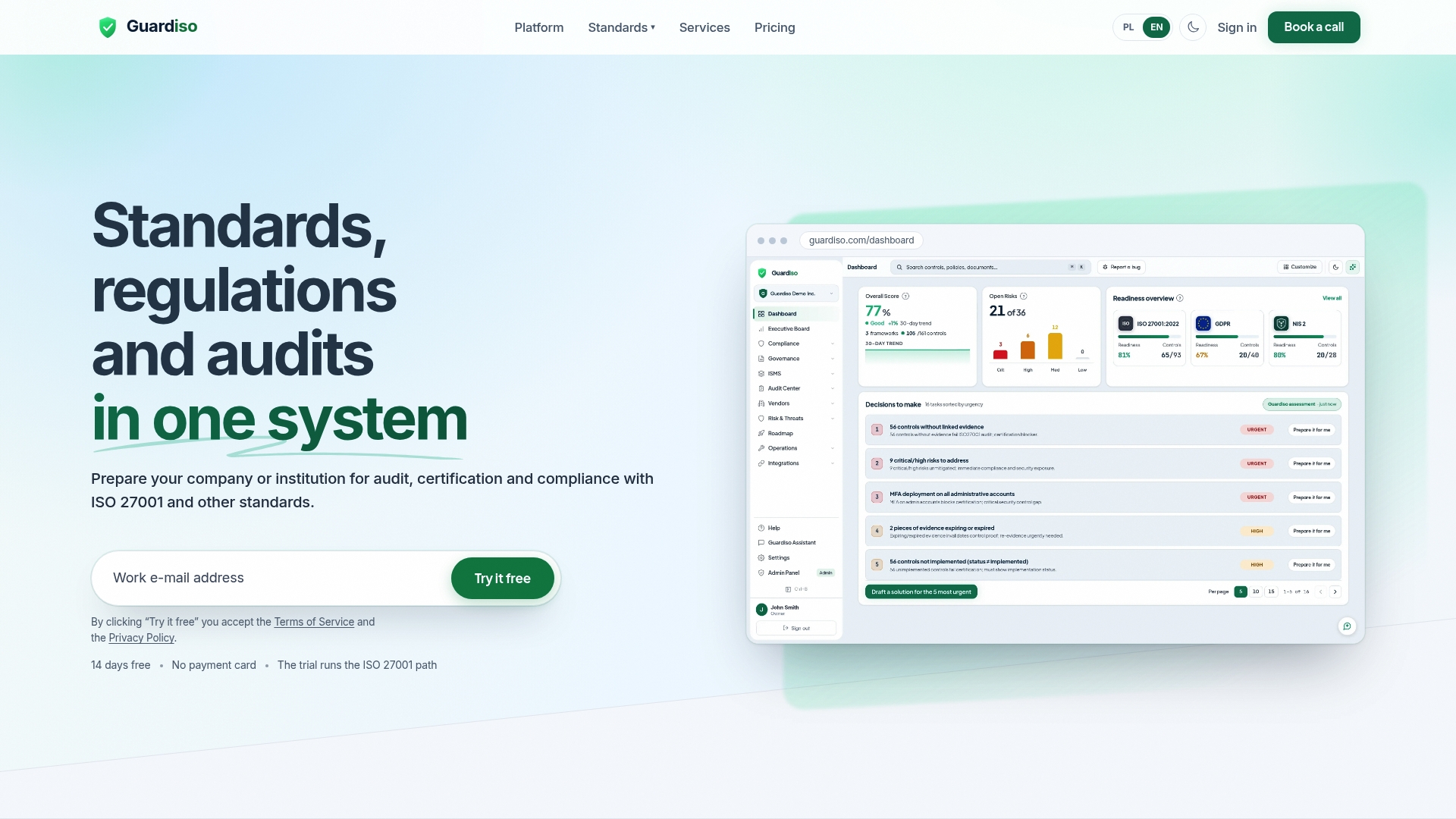
Guardiso is a GRC platform for ISO 27001, GDPR, NIS2, DORA, SOC 2, ISO 22301 and about 30 other standards. It maps standards to one set of documents and evidence, collects evidence through integrations, plans audits, shows status, risks and open tasks and prepares the evidence pack for the auditor. Data is stored only in the European Union. Guardiso is an ISO 27001 certified company.
Plans start with Starter at 199 € per month and Professional at 499 € per month, and Enterprise is priced on request. You can compare them on the pricing page.
If you also need an expert to run the security side, the vCISO service and the audit services sit alongside the platform.
FAQ
What does audit readiness mean?
It means you can show which requirements apply, which controls meet them, who owns each control and where current evidence is held. It also means weaknesses are tracked through corrective action and retesting. Readiness is kept up all year, so the audit becomes a review of work already done.
How long does it take to prepare for a compliance audit?
That depends on scope and the state of your records. The route to NIS2 compliance often spans one to three years according to BSI Group’s mapping tool. A company already running ISO 27001 controls and maintaining evidence continuously needs far less time before each audit.
Who should be told before an audit?
The European Commission’s guidance recommends informing employees of the dates, scope, criteria and objectives of the audit. Staff who own controls should also know what evidence they may be asked to produce and who coordinates replies.
Can one set of evidence serve several regulations?
Yes, when each control is written once and mapped to every requirement it supports. ISO/IEC 27001:2022 Annex A is a practical base for mapping NIS2 measures. Evidence attached to the control then serves each framework that refers to it.
Sources
- Compliance Audit Readiness: How to Prepare Before an Audit
- ENISA, Technical implementation guidance on cybersecurity risk management measures, June 2025
- ENISA, Auditing Security Measures, September 2013
- European Commission, General preparation for an audit, a good practice
- ISO 27001 Audit Checklist: Controls and Evidence
- Regulation (EU) 2022/2554 (DORA), EUR-Lex
- Institute of Internal Auditors, Integrated Auditing practice guide
- ACCA, Area K Audit guidance note